Thursday, 28 August 2014
Monday, 18 August 2014
Ganpati in the making - 1
Check out the Ganesha in the making. Made it last week. Took about 4 hours...spread over 2 days.
I am hoping to put the finished product once the painting is complete... a week from now... so that the progression can be seen.
This is the same "self hardening clay" from Michaels Art Store. The plan is to have a "Baala Ganesha" this time... with a curly head of hair... and a dhoti just above the knee roll and a mooshik looking up to Ganesha !
Sunday, 9 March 2014
Saturday, 18 January 2014
Tuesday, 31 December 2013
Symphony in Stone: Hampi -Part 2
Virupaksha Temple:
Vidyaranya was at the shrine of the Goddess Bhuvaneshvari Devi at the Virupaksha Temple in Hampi. The Goddess would not accede to his request and bless him with abundance of wealth. "No! It is not possible in this life for you!" she said. Immediately, Vidyaranya decided to renounce the world and took sanyaasa. Sanyaasa is like a second-birth for an individual. Devi was forced to yield. Abundant wealth was soon his, but as a sanyaasi, Vidyaranya had no personal interest in it. He served as the inspiration for Hukka (Harihara Raya) and Bukka Raya who together founded the Vijayanagar empire, which became one of the wealthiest empires of its time.
We are at the same Virupaksha Temple dedicated to Lord Shiva. Shiva is "Virupaksha", the one with an odd number of eyes- i.e. three eyes. Beside the shrine for Bhuvaneshvari Devi is Pampa Devi's sannidhi. At the back of the temple is a shrine for Vidyaranya in recognition of his immense contribution as a saint and in shaping the formation of the empire. Vidyaranya is also seen in one of the paintings on the ceiling of the "Ranga mandapa" within the temple precincts- It shows Hukka and Bukka welcoming the saint who is seated in a palanquin.
The Ranga mandapa is filled with other paintings depicting scenes from the Ramayana, the Mahabharata and the Puranas. Lord Rama breaking the bow to win Sita, Arjuna striking the fish with his arrow in Draupadi's swayamvara, the avataras of Vishnu, Kama targeting Shiva with his arrow of flowers and Shiva as Tripurantaka are some of the prominent ones.
An interesting feature in this temple is an example of the "pin-hole camera" concept. A room in the temple's interior lets in a pencil of light through an aperture facing the gopuram. On the opposite wall, the gopuram's inverted image is formed, making it a fascinating case study in Optics.
This temple predates the Vijayanagar period. However, the gopuram was added during the empire's time. Unlike the granite stones used to build the remainder of the temple, the gopuram was built using "Roman bricks". It paved the way for gopuram construction in South India as we know it today- undoubtedly, a product of the Vijayanagar mind.
| Virupaksha Temple Gopuram |
Hemakuta parvata:
The Virupaksha temple can be reached by crossing over the Hemakuta parvata (hill). Hemakuta parvata is a massive, granite monolith. At the base of the hill is a huge Ganesha in "ardha padmasana"posture, interestingly called the "mustard Ganesha". This name is used to differentiate it from an even bigger "groundnut Ganesha" on the other side of the hill. The "Mustard Ganesha" has the figure of a lady when seen from the back. Apparently, Parvati is holding the over-sized Ganesha on her lap! The idol is mutilated- possibly when Vijayangar fell a prey to the marauding armies of the Bahmani kings. Since the idols are defaced, none of these are functional temples. In fact, apart from the Virupaksha Temple, there are no functional temples at all.
| Mustard Ganapati- If this is a mustard in Hampi, then.... |
Hemakuta parvata is apparently the hillock where Shiva's penance was broken by Kama. The rest of the story is of course well known- Shiva's blazing third eye reduces Kama to ashes. Interestingly, the granite stones in Hampi are all igneous rocks- rocks formed when the lava cooled down after a volcanic eruption. The rocks have a reddish-brown hue- iron in the granite gets oxidised and leaves behind this colour. One wonders whether the story of "Kama dahana" actually points to these geological upheavals.
At the top of the Hemakuta parvata are a group of "joint temples"- i.e. temples with multiple sanctums. Today, "joint temples" have been corrupted in local parlance to "jain temples" giving these structures a totally different meaning (as per our guide)! The slopes of the Hemakuta parvata show a variety of experiments in granite temple construction. We notice a graded progression in complexity. Watchtowers dot the hill at various points.
How were these granites cut so precisely? We're told that the technique involved making incisions in the rock, inserting wooden pegs in them and filling them up with water. The water caused the wood to expand and the rock was sliced open.
The panoramic views from Hemakuta parvata are breathtaking- Numerous hills and hillocks- all rock and stone, punctuated with clumps of rich foliage. The spire of the Virupaksha temple pierces the sky and holds our attention for a while, before we drift off and let our imagination loose...and spot a dragon here or an elephant there...amongst the boulders!
| Virupaksha Temple seen from Hemakuta, to the left- the "joint temples" |
Vijayanagar City:
The number seven is significant to Vijayanagar, as per our guide. There were 7 fortresses guarding the city, 7 bazaars (selling horses, gems, supari! etc) and there are 7 hills, the prominent ones being Gandhamana, Hemakuta, Maalyavanta, Rishyamuka, Matanga and Anjanaadri.
At its high-point, Vijayanagar was 60 sq miles and housed half a million people.
We have written accounts of Vijayanagar from travellers who visited the city- Domingo Paes and Nuniz were Portuguese travellers, Conti was an Italian and Abdur Razzak was a Persian. Jawaharlal Nehru quotes in the "Glimpses of World History" that the kingdom was so affluent that the roads were lined with silk and gold for a distance of six miles!
Yoga Narasimha:
One of the most visible faces of Hampi is the Yoga Narasimha idol. Presently, Lakshmi is missing, while the rest of the idol is fairly intact and impressive.
![]() |
| Yoga Narasimha |
Vittala Temple:
By far, the most photographed monument at Hampi- the stone chariot and the musical pillars are not be missed. There are some interesting sculptures around the prakara- a single sculpture shows multiple animals as you cover different sections. Also seen is the "composite bull-elephant" sculpture- the idiom borrowed from the Badami cave temples.
The detailing to ensure that water drains off the sides of the chariot in a controlled trickle, is impressive. Vijayanagar had ties with distant lands like China and Rome. The Vittala Temple has pagoda-like arches and Chinese dragons, all carved in granite.
Granite does not lend itself to detailing. Badami sculptures are in sandstone, but the material is not durable. Hoysala sculptures are detailed, but carved out of softstone. The beauty of the Vittala Temple is that it is entirely crafted in granite, but still sculpted in a very delicate way.
It is about a kilometre's walk to the temple. Pillars stand as reminders of the bazaar which once populated this broad avenue. On the way, you can take a break and soothe your spirits by resting on the steps of the temple tank. The hills on either side of the avenue make this walk a very pleasant experience.
Hazara Ram temple:
Curiously named "Hazara Ram", this is a Rama temple inside the King's Palace. The name comes from the myriad images of Lord Rama carved on the temple's facade. The Ramayana is sculpted in panels in three levels- if you go around the temple thrice, in effect, you would have seen vignettes of the entire story! Each panel is engaging and can keep you riveted for hours.
The Queen's Palace, Bath and the King's Palace:
Except for the granite bases, nothing remains today. The palaces were made of wood and didn't survive the pillage of Vijayanagar. The king's palace is a sprawling complex with Roman style aqueducts, feeding into several tanks. Our imagination has to fill in for what is missing. A flight of rock-cut stairs takes us to a huge raised platform used by the king to survey the Dasara procession. The Mysore kingdom was an off-shoot of the Vijayanagar empire and inherited the tradition of the Dasara procession.
Next to the Queen's Palace is the Lotus Mahal- a multi-storeyed complex, with terracotta pipes carrying water, which served as an air-conditioner!
| Lotus Mahal: fitted with "air conditioners" |
Further, we have the elephant's stables- eleven of them, all built in Indo-Islamic style, with prominent domes and arches.
| Elephant Stables in Indo-Islamic style |
It is the end of the day. The sun dips, so does our energy level. The remaining sites can wait- there's Mourya Maney or "Morey Maney" as our guide pronounces which houses some neolithic-age cave paintings on the other side of the Tungabhadra. We can barely hear the guide. Fatigue takes over. We need some tea, a hot cup of tea!
Sipping the cup of tea in the comfort of the hotel room, we purse our lips... and linger once more on Hampi...and its delightful, over the top creations!
Monday, 30 December 2013
Symphony in Stone: Hampi- Part 1
You don't see monuments in Hampi. Hampi itself is one giant monument. You feel a little like Gulliver at Brobdingnag- bewildered by the enormous scale and proportions of nature as it chooses to unleash itself with a careless ease which defies description. Boulders of gigantic proportions are littered with abandon- they spring up in isolation, or appear in clumps- precariously balancing atop one-another in a delicate acrobatic act, so that at any moment, they might tumble down; an entire hillock- one single, granite slab...smooth as a bald pate, with not a blade of grass.. the rock-concert is numbing in its sheer variety!
This has to be Kishkinda of the Ramayana. Only the mighty Hanuman, Sugriva, Vali and the hordes of vanaras could have run on these hills and slopes and rearranged the rocks with intent... or simply stacked them up, in a mindless, mischievous exercise. References to the Ramayana abound at Hampi. There is Pampa sarovara- Kabandha, the rakshasa, directed Rama and Lakshmana to this lake so that they could find Sugriva...and through him, succeed in finding the whereabouts of Sita. Then, there is Anjanaadri, the stony hillock, where Hanuman was born. There is Matanga Hill in the distance- Matanga was Shabari's guru. Shabari's meeting with Rama is of course a well known episode in the epic. Next to the Matanga hill is Rishyamuka parvata- the hill where Sugriva and Hanuman hid from Vali's clutches because a curse made this hill out of bounds for Vali. There is even a Maalyavanta Parvata- another hill where Rama and Lakshmana spent the entire rainy season waiting, waiting for Sugriva to keep his promise and send his monkeys to trace Sita. We do not know when Hampi was identified with Kishkinda of yore, but the mapping is indeed apt.
The river Tungabhadra flows through Hampi. The natural flow of the river is restricted now, but the Tungabhadra Dam is a huge reservoir, with water stretching as far as the eye can see. There are a couple of canals which criss-cross Hospet township (next to Hampi) and despite the stony backdrop, the fertile sugarcane fields and plentiful vegetation are entirely the river's handiwork.
Hampi gets its name from "pampa" another name for Parvati- It was known as "pampa kshetra" in the past and appears to have been well known even prior to the Vijayanagar kingdom which was established here, about 500 years ago.
Vijayanagar empire:
Hampi was the capital of the Vijayanagar empire which flourished for 229 years- from 1336 to 1565. What was India like at this time? 1336 was the time when Mohammad Bin Tughlaq ruled Delhi. Where does Tughlaq fit in the list of Delhi kings? When we talk about muslim rule, we need to remember the following chronology- Mohammad of Ghazni, Ghori, the "slave" dynasty beginning with Qutb-ud-din Aibak, the Khiljis, the Tughlaqs, the Sayyids, the Lodis, Babur, Humayun, Akbar, Jehangir, Shah Jahan and Aurangzeb...in that order. It is roughly the timeline..starting from the 10th century right up to 1707, when Aurangzeb died.
Of these, Alauddin Khilji is an important character in the rule of the Khiljis as far as South India is concerned. Alauddin Khilji's army general was Malik Kafur- who went as far as Madurai and Srirangam and supposedly, plundered the temples. Swami Vidyaranya, Shankaracharya of the Shringeri matha was a witness to these events. A great Vedantic scholar and a visionary, his role was pivotal in bringing together Hukka and Bukka as the first Vijayanagar kings and selecting Hampi as the capital city of this empire.
After Alauddin Khilji, the next important Delhi sultan in our Vijayanagar story is Mohammad Bin Tughlaq. Hukka (Harihara Raya) and Bukka Raya were captured by Tughlaq's men. Later, they were sent by Tughlaq's men to quell the revolts in the Deccan. But they ended up being the founders of the Vijayanagar empire.
Krishnadeva Raya was of course the greatest king of the Vijayanagar empire who ruled for 20 years (1509 to 1529). The Vijayanagar empire did not last even 40 years after his death. In 1565, in the battle of Talikota (near Bijapur), the Vijayanagar empire lost to the Bahmani kings of the Deccan. The kingdom and Hampi was totally wiped out and never built again. When the Vijayanagar empire went down, Akbar was the ruler at Delhi.
Thus, the Vijayanagar empire flourished during those 200 years when the Delhi throne was occupied by the Tughlaqs and was decimated around Akbar's time. It is this time frame that we want to focus on...when we are at Hampi.
Who were these Bahmani kings who brought about the abrupt end to the Vijayanagar empire? Well, Mohammad Bin Tughlaq had the bright idea of shifting the capital city from Delhi to Daulatabad in Maharashtra. This led to a revolt of the "nobles" in Daulatabad and led to the formation of the Bahmani empire. Later, the Bahmani empire broke into 5 kingdoms- which ruled from Bijapur, Bidar, Golconda, Berar and Aurangabad. Thus, the Bahmani kingdom and Vijayangar kingdom were formed and grew around the same time. The two kingdoms were constantly at war with each other and the history of Vijayanagar is essentially a record of these clashes. In 1565, all the 5 Bahmani kingdoms combined and attacked Vijayanagar. That was the end of Vijayanagar empire.
As far as the Bahmani kings themselves were concerned, they were all systematically attacked by the mughals and their territory annexed to the Delhi Sultanate. How Aurangazeb laid siege to Golconda for 8 months and eventually captured the city through devious means is the topic of an entire light-and-sound show at the Golconda Fort, Hyderabad.
Eventually, the Bahmani kings...the hunters, as far as Vijayangar and Hampi are concerned, became the hunted. Such is history.... a sad chronicle of perennial strife and conflict.
But between two conflicts was a lull, a momentary lull.... and in that suspended state, people rejoiced, there was gurgling laughter and merriment once more- painting and poetry, music and sculpture... flowed and flourished!
Such is life!
| Hampi- It rocks! |
This has to be Kishkinda of the Ramayana. Only the mighty Hanuman, Sugriva, Vali and the hordes of vanaras could have run on these hills and slopes and rearranged the rocks with intent... or simply stacked them up, in a mindless, mischievous exercise. References to the Ramayana abound at Hampi. There is Pampa sarovara- Kabandha, the rakshasa, directed Rama and Lakshmana to this lake so that they could find Sugriva...and through him, succeed in finding the whereabouts of Sita. Then, there is Anjanaadri, the stony hillock, where Hanuman was born. There is Matanga Hill in the distance- Matanga was Shabari's guru. Shabari's meeting with Rama is of course a well known episode in the epic. Next to the Matanga hill is Rishyamuka parvata- the hill where Sugriva and Hanuman hid from Vali's clutches because a curse made this hill out of bounds for Vali. There is even a Maalyavanta Parvata- another hill where Rama and Lakshmana spent the entire rainy season waiting, waiting for Sugriva to keep his promise and send his monkeys to trace Sita. We do not know when Hampi was identified with Kishkinda of yore, but the mapping is indeed apt.
| This has to be Kishkinda! |
| Every stone has a story...an epic story |
The river Tungabhadra flows through Hampi. The natural flow of the river is restricted now, but the Tungabhadra Dam is a huge reservoir, with water stretching as far as the eye can see. There are a couple of canals which criss-cross Hospet township (next to Hampi) and despite the stony backdrop, the fertile sugarcane fields and plentiful vegetation are entirely the river's handiwork.
Hampi gets its name from "pampa" another name for Parvati- It was known as "pampa kshetra" in the past and appears to have been well known even prior to the Vijayanagar kingdom which was established here, about 500 years ago.
Vijayanagar empire:
Hampi was the capital of the Vijayanagar empire which flourished for 229 years- from 1336 to 1565. What was India like at this time? 1336 was the time when Mohammad Bin Tughlaq ruled Delhi. Where does Tughlaq fit in the list of Delhi kings? When we talk about muslim rule, we need to remember the following chronology- Mohammad of Ghazni, Ghori, the "slave" dynasty beginning with Qutb-ud-din Aibak, the Khiljis, the Tughlaqs, the Sayyids, the Lodis, Babur, Humayun, Akbar, Jehangir, Shah Jahan and Aurangzeb...in that order. It is roughly the timeline..starting from the 10th century right up to 1707, when Aurangzeb died.
Of these, Alauddin Khilji is an important character in the rule of the Khiljis as far as South India is concerned. Alauddin Khilji's army general was Malik Kafur- who went as far as Madurai and Srirangam and supposedly, plundered the temples. Swami Vidyaranya, Shankaracharya of the Shringeri matha was a witness to these events. A great Vedantic scholar and a visionary, his role was pivotal in bringing together Hukka and Bukka as the first Vijayanagar kings and selecting Hampi as the capital city of this empire.
After Alauddin Khilji, the next important Delhi sultan in our Vijayanagar story is Mohammad Bin Tughlaq. Hukka (Harihara Raya) and Bukka Raya were captured by Tughlaq's men. Later, they were sent by Tughlaq's men to quell the revolts in the Deccan. But they ended up being the founders of the Vijayanagar empire.
Krishnadeva Raya was of course the greatest king of the Vijayanagar empire who ruled for 20 years (1509 to 1529). The Vijayanagar empire did not last even 40 years after his death. In 1565, in the battle of Talikota (near Bijapur), the Vijayanagar empire lost to the Bahmani kings of the Deccan. The kingdom and Hampi was totally wiped out and never built again. When the Vijayanagar empire went down, Akbar was the ruler at Delhi.
Thus, the Vijayanagar empire flourished during those 200 years when the Delhi throne was occupied by the Tughlaqs and was decimated around Akbar's time. It is this time frame that we want to focus on...when we are at Hampi.
Who were these Bahmani kings who brought about the abrupt end to the Vijayanagar empire? Well, Mohammad Bin Tughlaq had the bright idea of shifting the capital city from Delhi to Daulatabad in Maharashtra. This led to a revolt of the "nobles" in Daulatabad and led to the formation of the Bahmani empire. Later, the Bahmani empire broke into 5 kingdoms- which ruled from Bijapur, Bidar, Golconda, Berar and Aurangabad. Thus, the Bahmani kingdom and Vijayangar kingdom were formed and grew around the same time. The two kingdoms were constantly at war with each other and the history of Vijayanagar is essentially a record of these clashes. In 1565, all the 5 Bahmani kingdoms combined and attacked Vijayanagar. That was the end of Vijayanagar empire.
As far as the Bahmani kings themselves were concerned, they were all systematically attacked by the mughals and their territory annexed to the Delhi Sultanate. How Aurangazeb laid siege to Golconda for 8 months and eventually captured the city through devious means is the topic of an entire light-and-sound show at the Golconda Fort, Hyderabad.
Eventually, the Bahmani kings...the hunters, as far as Vijayangar and Hampi are concerned, became the hunted. Such is history.... a sad chronicle of perennial strife and conflict.
But between two conflicts was a lull, a momentary lull.... and in that suspended state, people rejoiced, there was gurgling laughter and merriment once more- painting and poetry, music and sculpture... flowed and flourished!
Such is life!
The cave temples of Badami
Brown, pillar-like hills stack up against the blue afternoon sky as we drive towards Badami from Aihole. Badami gets its name from the "almond coloured" (badami) hills, our guide informs us. The comparison is apt- like the almond, the hills are brown and even have a texture resembling the almond- with furrowed vertical crevices lining the entire hill facade.
Vatapi and Agastya:
The ancient name of the city of Badami is Vatapi. Vatapi figures prominently in the mythological story involving the Sage Agastya. Amar Chitra Katha captures the details beautifully. Agastya migrates from North India to the South. He reaches Vatapi which is ruled by the Asura brothers- Vatapi and Ilvala. Ilvala has a devious plan to kill brahmanas by cooking his brother Vatapi and feeding the guests with his meat. Once inside the stomach, Ilvala would call "Vatapi"... and out came Vatapi, tearing the insides of the hapless brahmana. Many a brahmana met his end this way. But not Agastya- he was equal to the task. Once he had comsumed his food, he burped... and burped so audibly, that Vatapi was digested for good!
The guide informs us that the Greek astronomer Ptolemy actually visited this site and recorded it as "Badami" with a slight corruption. Ptolemy lived in the first century after Christ. The cave temples came up only in the seventh century. Badami appears to have had some standing even before it became the capital of the Chalukyas. The name "Badami" too appears to be an ancient one, given this anecdote about Ptolemy.
A flight of rock-cut stairs takes us to the Cave Temples. From this perch, the Agastya Lake is seen down below, shimmering in a deep shade of emerald-green. Hugging the lake at the farther end is the Bhutnath temple, dedicated to Lord Shiva. As the wind blows, the limpid waters of the lake registers a ripple... and the inverted image of the temple...sways ever so gently. A closer scrutiny reveals that there are in fact two temples- one on the Northern side and another on the Eastern front. The hills in the distance reveal numerous sandstone structures- but time is limited, and we have just enough to explore the cave temples.
Badami was the capital of the Chalukyas who ruled in the 7th century. The hills tower above the caves and remnants of a fort can be seen. The Chalukyas found these hills to be a strategic location for their capital and constructed the fort. Tipu Sultan took possession of the fort in the 18th century. Some of the cannons that Tipu fitted stick out of the fort walls.
Essentially, there are 4 caves. The first one is dedicated to Lord Shiva, the second and the third are dedicated to Lord Vishnu and the fourth to Mahavira. These cave-temples were the first temples constructed by the Chalukyas, the free standing temples at Aihole came later and finally came the structures at Pattadakkal.
Cave 1:
The most endearing sculpture of Shiva as Nataraja greets us at the first cave. Unlike Nataraja's usual stance with 4 hands, this has 18, nine on either side! With each hand on the left-side, we have 9 combinations, with every other hand on the right- a total of 81 postures, all in a single image! Apparently, Sage Bharata talks about 81 postures in his Natya Shastra and all of the them are condensed in this sculpture. Another differentiator is that unlike Nataraja who has his right foot pinned to the goblin (Apasmara), in this sculpture, the foot is on a lotus. It is a dance of happiness, an "ananda taandava", the guide informs us. Ganesha also seems to join Shiva in this dance.
Kartikeya on a peacock graces another panel. Apparently, Kartikeya was one of the main deities of the Kadambas, who preceded the Chalukyas. His influence seems to have continued to Chalukyan times.
On one wall is the majestic figure of Ardha Naareeshwara-half Shiva and half Parvati . The story of the Sage Bhringi unfolds on this panel. Bhringi refused to circumambulate around Parvati. His reverence is only for Shiva. But then, Parvati is the one who blesses with health- and devoid of her grace, Bhingi is reduced to a grotesque, skeleton-like figure. It is at this point that Shiva and Shakti manifest as Ardha-naareeshwara symbolising that Shiva and Shakti are inseparable and form a composite whole at all times.
On the other side is the grand figure of "HariHara"- half Shiva and half Vishnu. Chalukyan art has a disproportionate number of "composite deities"- there's Ardha Naareeshwara, there's Harihara and a Narasimha (in the Vishnu cave). In cave 1 itself, there is an image of a bull and an elephant intertwined- cover one side and you see a bull, cover the other, and you see an elephant. The bull-elephant idiom has since been repeated at other places- at Hampi and even at Thanjavur. But, these caves seem to have started the trend, which caught the imagination of later sculptors.
Cave 2 and 3:
Both these caves are dedicated to Lord Vishnu. In the first, Lord Vishnu is seated on Adi Sesha, as opposed to the reclining posture that we are used to nowadays. The images are gigantic and larger than life.
Lord Vishnu as Trivikrama takes over an entire wall. The story of Vamana Avatara springs to life- a small image of Vamana, Bali Chakravarty and his teacher Shukracharya are clearly delineated. Finally, it is Trivikrama who takes centre-stage. One foot on the ground.. and the other raised....right up to the very heavens. Where is the room for the third step, he seems to question.
Trivikrama appears twice, in Cave 2 and Cave 3. So, does Varaha. The Chalukyan sculptors have a special fascination for Varaha. He was the emblem of the Chalukyas, no doubt. The stance is majestic, with Bhoomi Devi, held aloft on his snout, and watched by denizens of the different lokas.
A radiant, standing Narasimha idol jumps out at us. It is a massive work and remarkably different from the more famous "seated-Narasimha" that we see in current temples.
There are also exquisite figurines of couples on the upper walls. They seem to have served as the inspiration for the Hoysala figures at Belur and Halebeedu which were carved much later.
In one of the caves, curiously, Shukracharya (in the Trivikrama panel) bears a striking resemblance to Buddha. He has the same curly hair and wears robes which match the Buddha as well.
Cave 4:
This cave has the idol of Mahavira, the 24th tirthankara in the sanctum. The 23rd tirthankara- Parshvanath is seen on an entire wall- easily identified by the hooded snake which looms over his head. On the opposite wall is the figure of Bahubali or Gomateshwara, son of the second Tirthankara, Ajitanatha. Bahubali can be recognised by the host of creepers twirling over his body.
Almost 400 years later, the very same image, complete...with the creepers was carved at Sravanabelagola. Again, it was Chalukyan art which set the standard for later works.
All the caves are in exceptionally good shape- almost unmutilated and unaffected by the ravages of time. In some places, it is evident that the walls which appear vacant now, were filled with paintings, made with some kind of herbal paint. The colours are still visible in a few places- a dash of green here, a patch of red there and in some places, a faint hint of a human figure outline.
Monkeys rule these caves, ever on the lookout to snatch away food from the inattentive tourist. I was attentive, very attentive, as I walked down the steps with a bottle of mineral water. Surely, monkeys wouldn't need that. I was wrong. Accosted by a rather aggressive monkey, I had little choice but to hand him over the bottle. I didn't look back, just ran for cover! I was later told that the monkey took the bottle, smartly opened the lid and downed the contents in style!
Vatapi and Agastya:
The guide informs us that the Greek astronomer Ptolemy actually visited this site and recorded it as "Badami" with a slight corruption. Ptolemy lived in the first century after Christ. The cave temples came up only in the seventh century. Badami appears to have had some standing even before it became the capital of the Chalukyas. The name "Badami" too appears to be an ancient one, given this anecdote about Ptolemy.
A flight of rock-cut stairs takes us to the Cave Temples. From this perch, the Agastya Lake is seen down below, shimmering in a deep shade of emerald-green. Hugging the lake at the farther end is the Bhutnath temple, dedicated to Lord Shiva. As the wind blows, the limpid waters of the lake registers a ripple... and the inverted image of the temple...sways ever so gently. A closer scrutiny reveals that there are in fact two temples- one on the Northern side and another on the Eastern front. The hills in the distance reveal numerous sandstone structures- but time is limited, and we have just enough to explore the cave temples.
Badami was the capital of the Chalukyas who ruled in the 7th century. The hills tower above the caves and remnants of a fort can be seen. The Chalukyas found these hills to be a strategic location for their capital and constructed the fort. Tipu Sultan took possession of the fort in the 18th century. Some of the cannons that Tipu fitted stick out of the fort walls.
Essentially, there are 4 caves. The first one is dedicated to Lord Shiva, the second and the third are dedicated to Lord Vishnu and the fourth to Mahavira. These cave-temples were the first temples constructed by the Chalukyas, the free standing temples at Aihole came later and finally came the structures at Pattadakkal.
Cave 1:
The most endearing sculpture of Shiva as Nataraja greets us at the first cave. Unlike Nataraja's usual stance with 4 hands, this has 18, nine on either side! With each hand on the left-side, we have 9 combinations, with every other hand on the right- a total of 81 postures, all in a single image! Apparently, Sage Bharata talks about 81 postures in his Natya Shastra and all of the them are condensed in this sculpture. Another differentiator is that unlike Nataraja who has his right foot pinned to the goblin (Apasmara), in this sculpture, the foot is on a lotus. It is a dance of happiness, an "ananda taandava", the guide informs us. Ganesha also seems to join Shiva in this dance.
Kartikeya on a peacock graces another panel. Apparently, Kartikeya was one of the main deities of the Kadambas, who preceded the Chalukyas. His influence seems to have continued to Chalukyan times.
![]() |
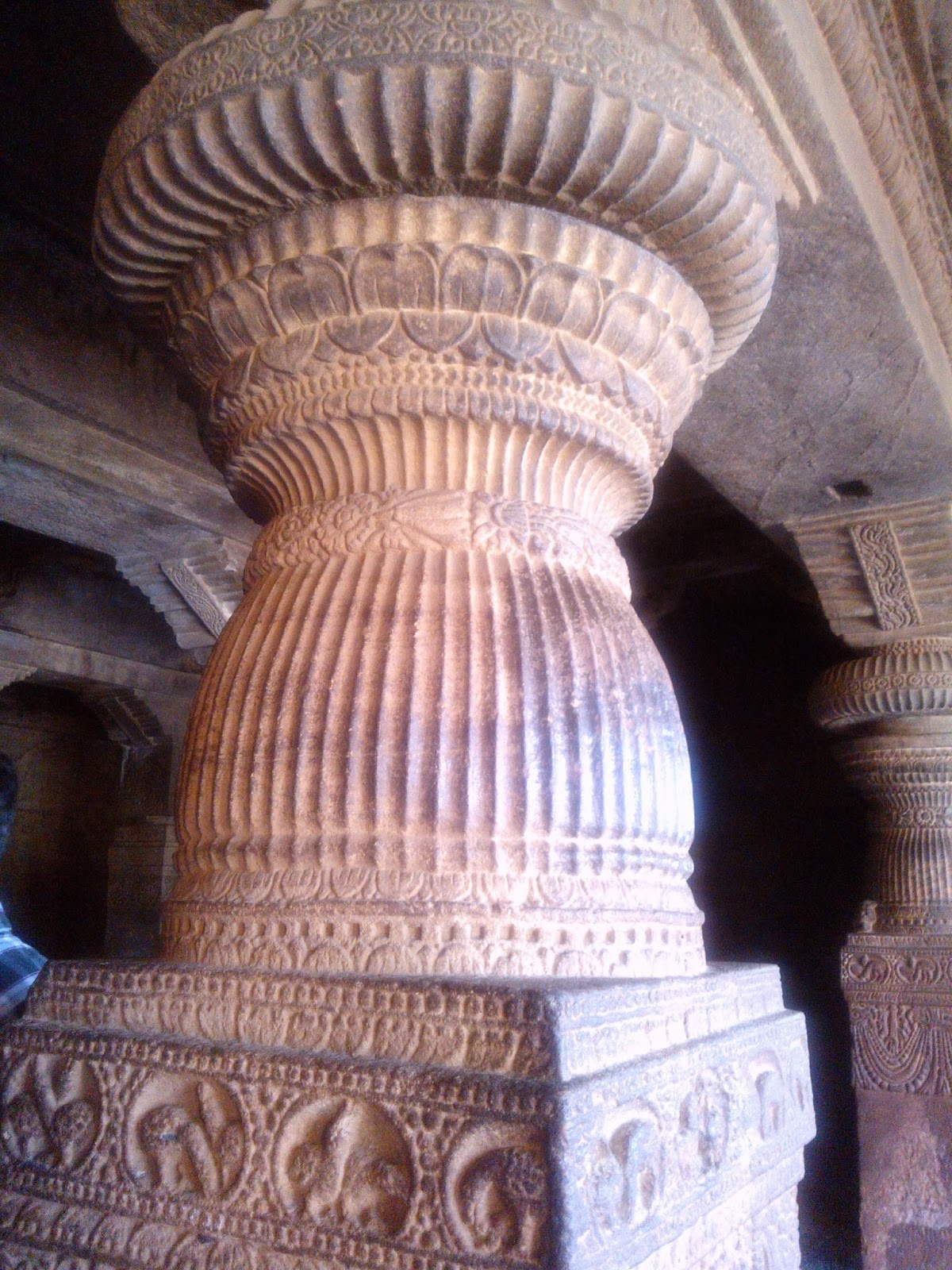
| What lathe machine did they have then!? |
On one wall is the majestic figure of Ardha Naareeshwara-half Shiva and half Parvati . The story of the Sage Bhringi unfolds on this panel. Bhringi refused to circumambulate around Parvati. His reverence is only for Shiva. But then, Parvati is the one who blesses with health- and devoid of her grace, Bhingi is reduced to a grotesque, skeleton-like figure. It is at this point that Shiva and Shakti manifest as Ardha-naareeshwara symbolising that Shiva and Shakti are inseparable and form a composite whole at all times.
![]() |
| Ardhanaareeshwara |
On the other side is the grand figure of "HariHara"- half Shiva and half Vishnu. Chalukyan art has a disproportionate number of "composite deities"- there's Ardha Naareeshwara, there's Harihara and a Narasimha (in the Vishnu cave). In cave 1 itself, there is an image of a bull and an elephant intertwined- cover one side and you see a bull, cover the other, and you see an elephant. The bull-elephant idiom has since been repeated at other places- at Hampi and even at Thanjavur. But, these caves seem to have started the trend, which caught the imagination of later sculptors.
![]() |
| Harihara |
![]() |
| Harihara |
Cave 2 and 3:
Both these caves are dedicated to Lord Vishnu. In the first, Lord Vishnu is seated on Adi Sesha, as opposed to the reclining posture that we are used to nowadays. The images are gigantic and larger than life.
![]() |
| Vishnu seated on Adisesha |
Trivikrama appears twice, in Cave 2 and Cave 3. So, does Varaha. The Chalukyan sculptors have a special fascination for Varaha. He was the emblem of the Chalukyas, no doubt. The stance is majestic, with Bhoomi Devi, held aloft on his snout, and watched by denizens of the different lokas.
A radiant, standing Narasimha idol jumps out at us. It is a massive work and remarkably different from the more famous "seated-Narasimha" that we see in current temples.
![]() |
| Narasimha |
There are also exquisite figurines of couples on the upper walls. They seem to have served as the inspiration for the Hoysala figures at Belur and Halebeedu which were carved much later.
In one of the caves, curiously, Shukracharya (in the Trivikrama panel) bears a striking resemblance to Buddha. He has the same curly hair and wears robes which match the Buddha as well.
Cave 4:
This cave has the idol of Mahavira, the 24th tirthankara in the sanctum. The 23rd tirthankara- Parshvanath is seen on an entire wall- easily identified by the hooded snake which looms over his head. On the opposite wall is the figure of Bahubali or Gomateshwara, son of the second Tirthankara, Ajitanatha. Bahubali can be recognised by the host of creepers twirling over his body.
Almost 400 years later, the very same image, complete...with the creepers was carved at Sravanabelagola. Again, it was Chalukyan art which set the standard for later works.
All the caves are in exceptionally good shape- almost unmutilated and unaffected by the ravages of time. In some places, it is evident that the walls which appear vacant now, were filled with paintings, made with some kind of herbal paint. The colours are still visible in a few places- a dash of green here, a patch of red there and in some places, a faint hint of a human figure outline.
Monkeys rule these caves, ever on the lookout to snatch away food from the inattentive tourist. I was attentive, very attentive, as I walked down the steps with a bottle of mineral water. Surely, monkeys wouldn't need that. I was wrong. Accosted by a rather aggressive monkey, I had little choice but to hand him over the bottle. I didn't look back, just ran for cover! I was later told that the monkey took the bottle, smartly opened the lid and downed the contents in style!
![]() |
| View from the caves |
P.S: It is interesting to note that the Elephanta Caves, close to Mumbai haven't been exactly dated. There are numerous theories, amongst which, is the suggestion that those caves may have been carved by the Chalukyas. This is an angle worth exploring. The style and content at Elephanta Caves bear a resemblance to these caves at Badami.
Subscribe to:
Posts (Atom)