Friday, 3 May 2019

Of lizards, tails and tales!

"Disgust and fear" - a twin-emotion which wells up the moment we mention "lizard". Think a little more, and the face contorts, the arms stiffen, the body gives a little twitch...and shivers go down the spine! It is instinctive, much like the feeling of a finger-nail scratching the blackboard! We cannot help it. It is a throwback to our past, down to that day when the lizard suddenly leaped and landed on the head! And the rest of the events which unfolded- a quick peek into the "panchaang" and the foreboding of certain death! The fear and disgust never went away.


We don't exactly know why we find lizards creepy. It's a feeling we hold for reptiles as a species, and for lizards in particular. May be, because they share the home-space with us in such an intimate way. Glance up and you see the lizard- in ones, in twos...and suddenly several of them- pale-pink, brown, jet-black and even spotted. A little head bobs out of the crack in the ceiling, a tail dangles out of the tube-light,  one is tantalizingly poised over the door-sill and another dashes at breakneck speed across the diagonal of the wall! Now, who is going to enter that bedroom, switch the lights off and spend a night there? Not me!


Driving out a lizard is an exercise in futility. You keep the windows and door wide open and a use a stick to prod the lizard out. As in any venture, there's exactly one person doing the ugly job. Directors are many. You hear an excited running commentary- on where the lizard now lurks, from various vantage points at ground-zero. The objective is simple- you tap the stick and coax the lizard out of the window. There is some success, no doubt. Over the background noise of shrieks and screams, you manage to shake the lizard out of his slumber...and lead him in the direction of the window. One more tap and he should be out! The mood is expectant and upbeat, but life is never so easy. Only two things happen with the next tap- he has now retraced his path back to his original home, or worse, found a new home, behind an old photo-frame. There are just too many obstacles out there- curtains, light-fixtures, wall-hangings, photo-frames and paintings. The process begins all over again. To your horror, since the window is now open, you have just let in one more friend into the room. After a point, it is terribly frustrating, numbed as you are, with a neck-ache. You have half a mind to swing the stick wildly and break everything in its wake, if that can take care of the lizard. Thankfully, discretion as they say, is a better part of foolhardiness! We miss the basic point- this is the lizard's home as much as ours!


Sometimes, you do get the lizard, at least a part of him! The stick lands on the lizard, smack on his tail. Faced with this existential crisis, the lizard gives the slip- neat and simple.....he ejects his tail out! Disgust is now magnified several fold- the lizard darts across sans tail.....while the tail comes tumbling down at you! May be, Mother lizard comforted her kid that day- "what blow came straight for the head, at least it went off....with just the crown!" or an equivalent lizardian-tail proverb! We don't know.


With monsoons, nature comes alive. Winged-termites swarm all over the tube-light. Lizards go "chip-chip-chip"- their calls exchanged across the room. For them, it is a veritable feast as they stalk and nab their prey. We fear that by the next morning, they would have grown to crocodile-like proportions and would have crowded us out of the room!
Lizards find homes you least expect. One had crawled his way up the water-tube...into the geyser. Switch the geyser on and he is there….his snout and fore-paws....clearly defined against the red of the geyser light! And refraction doing the trick to make him look like a giant....much like a T-Rex! Any takers for a bath with a lizard please? And the other time, when he stepped right into an open bottle of white shoe-polish! I told my sister to keep it closed! Just when I reached out for the bottle, he crawled out....all white and dripping....leaving a trail of white paw-marks all over the floor and up the wall!


The cosy confines of a lizard-free home is a fitting place for reflection! End of the day, lizards are very much a part of creation and our lives. They keep insects at bay. We look at them with disgust; perhaps, they will evaluate us the same way. The more keenly we observe, there is beauty even in a lizard. We admire the lizard's paws, much like a child's tiny fingers, his beady eyes, his mottled skin and his agility.
If not anything, we appreciate a lizard's presence of mind and his sense of humour in finding novel ways to outwit us!


.

Friday, 12 April 2019

Where have they all gone?

The balloon seller was a fixture each evening. He peddled his wares at the park and stopped by the neighboring houses. He walked around with a vertical-prop...the tops of which bulged with balloons- balloons of all shapes, sizes and colors! Children hung around him and followed him as if he were Pied-Piper! Such was his pull. Occasionally, parents yielded to the child's whims and bought may be... one balloon. Mostly, they took a different route out of the park so that the balloon-seller's bait wouldn't tempt the child and result in an evening of uncontrollable tantrums. It was not only balloons he sold.  He carried bows and arrows gilded in gold and even a miniature TV. The TV had a little knob. Twirl it...and your favorite movie-stars appeared on screen- now Amitabh, now Rajesh Khanna, now Hema Malini. You get it? The gadget was delicate. It worked a few times all right. But if the child gave a little more pressure to the knob, it cracked. You were now stuck with a non-functional TV which wouldn't scroll anymore. Parents threw a fit for wasting money on this silly purchase.  No worries! You sliced the TV belly...pulled out the picture-scroll and glanced at your favorite-stars...all at once!
Another favorite was the "magic-window" contraption- a red-colored paper with a glass at the center. Depending on how you folded the paper...once, twice...thrice...a different picture appeared on the glass! It was magic- enough to keep the child busy for at least that evening!
Sometimes, a different balloon seller came by...with a cylinder in toe. Out of the cylinder...hung balloons...taut...and straight. They were "gas" balloons- helium balloons. He didn't appear to have much success. Parents kept their children away as if he were a child-snatcher. Rumors were rife...that the gas balloons had so much "power"...that one child actually got airlifted...and was carried away into the clouds!!


It was not easy to get cotton-candy. We looked for him each day during the summer holidays. It was a delight when the candy-floss-wala came to the neighborhood. He carried a huge glass-cube. Neatly piled inside the cube...were candy-floss balls- pink in color and fluffy. No- you never got a full candy-floss ball. The candy-floss wala was a sculptor with magic in his fingers. He would pull out an "umbrella" mold and press the cotton-candy against it. What came out was a cotton-candy umbrella. He added a little crown, a stick to prop up the umbrella and with a flourish, handed it over to the child! If you paid a rupee more, he made a cotton-candy bird...with beak and crown, feathers and tail! His creations were limited...it was either the umbrella or the bird. For a child, it meant the whole world...as it dug into the cotton-candy with relish...and had its entire face...cheeks, jaws, ears...all smeared a deep pink!


The quiet of lazy, summer afternoons was broken with a twang. The sound was unmistakable. It went twang-twang-twang continuously. Part the curtains...and you a saw a strange man carrying a strange weapon....which looked like an oversized AK-47. (No AK-47s existed then, the comparison is for the current generation!) The rest of the afternoon had a familiar ring. Out of every home emerged old bedding rolls- bedding rolls which had become limp and thin since the cotton wasn't fluffy anymore. The AK-47 fluffed up the cotton....and gave these bedding rolls a new lease of life! As for swaccha-bharat, it didn't matter. The whole neighborhood was filled with a haze which hung for the rest of the day...wisps of cotton flying all over and an odious smell which went with it!


Entertainment was often on the footpath. It came looking for you, when you lost interest in life. One afternoon, the magician took over the entire footpath. It was not the old-Indian  rope trick, but something similar. He had a boy step into a basket and in full public view, had him disappear into thin-air! The trick took time. The magician was a master story-teller, and stretched his trick for a whole hour. It served multiple purposes- there was a gradual build-up to the excitement and the eventual denouement. Also, he waited till the audience swelled and spilt onto the road. Once you were a spectator, you were simply hooked. You had to wait till the boy disappeared and miraculously re-appeared to collect the entertainment-fee from a dumb-founded audience! It was an afternoon well spent; there was anyway nothing better to do.


Where have all these people gone? Where is the knife-sharpener-wala with his cycle-wheel which ejected sparks, where is that "bhaji-wala" who knocked each door with his grocery basket? Where is that monkey-man....who entertained us with his monkeys? Where is that cow which answered all our questions about the future with a nod of its head...so that we knew exactly how the future is going to pan out? Where is that man who led this cow....and created a racket with that drum which went boom-boom-boom? Where is that fiddle-wala who sold those coconut-shell fiddles which produced music in his hands and the moment he transferred it to us, the same fiddle croaked like a crow with sore-throat? Where is that man who sat by the roadside working on his toothpick...whose only occupation was to give elaborate directions to anyone who lost his way? "Somanathapura? Turn rightu…turn leftu…turn rightu…adhey!" Why did he lose his job...lose his job...to...GoogleMaps of all things?


Where have all these folks gone? Like the Neanderthal man, they have become extinct, rendered irrelevant with the passage of time. It was inevitable. But they live on...in our memories...memories of childhood.
I can feel it now...getting under the hood of the bioscope-wala…the black cloth draped over my head. As I strain my eyes...and get used to the darkness...I can see the characters slowly coming to life. It is a whole new world...fairy-tale-like and most beautiful, with song and dance and mindless revelry! I am there! Don't bring me back!


Ramana Maharishi painting in oils

Painted about a couple of months ago. About 3ft by 2.5 ft.
Bhagavan's picture is now in the living room.....just ahead as I type these lines.


It's as if....anytime we feel less than 100%....we just have to gaze at Maharishi's face. The expression...."prahasann iva".....just that hint of smile....and the eyes filled with compassion.
Is there any face....more serene...more beautiful?


Monday, 31 December 2018

The temple at Tiruvottriyur

Truvottriyur is in North Chennai.....just past the Chennai Harbor. A quick drive on Chennai's famed Beach Road takes us to Tiruvottriyur.


The word "ottri" means to "exempt" or "to keep away". As per the sthala puranam at Tiruvottriyur, once upon a time, there was a deluge. The ocean threatened to engulf everything in its wake. Devotees prayed to Lord Shiva. Shiva acceded to their request and the ocean spared this piece of land. Hence, the name "ottriyur" or "Tiru-ottriyur".


We had a little talk with the temple priest. He had some interesting stories to narrate. It seems, after the deluge, this was the first temple which came up here. Hence, the name of Shiva as "aadi-puri-ishvara".  Adipureeshvara is not a conventional linga. The naaga, i.e. snake itself is the linga. It is kept covered in a golden armor through out the year except for three days when the armor is removed. Abhishekam is possible only on these three days.


Everything is in two-s at the temple- there are two shrines for Shiva: as Adipureeshvara and as Tiruvottreeshvara. There are two shrines for Devi: as Kali and as BalaTripuraSundari.
There are two sthala vrikshas: "atti" and "magizham".

Kali at the temple was in ugra rupa to the extent that even human-sacrifice was done in the past! Adi Shankara installed a circular (vattam in Tamil) srichakra and quelled Kali's anger and converted her into a benign deity.  Hence, the name of the deity as "vatta-parai-amman".
Tiruvottreeshvara is a conventional Shiva linga. Regular abhishekam is only for this linga.
We reached in time for the evening abhishekam for Devi. Devi as Bala-tripura-sundari is beauty personified!


There is connection between this temple and the one at Tiruvarur in Thanjavur district. The utsava murti is Tyagaraja, as Somaskanda (sa uma skanda)- Shiva with Uma and Skanda. It is a replica of the one at Tiruvarur.


There are 27 shiva lingas, one for each of the nakshatras, at this temple. This is one of the unique features of this temple.


Kaliya naayanaar:


One of the 63 naayanmaars, Kaliya naayanaar is primarily associated with Tiruvottriyur. He used to light lamps inside the temple. Once wealthy, he lost all his money. It came to a point when he had no money to buy oil to light the lamp. He decided to slit his throat and use his own blood to light the lamp. He is prevented by Lord Shiva. This stirring story is documented in the "periya puranam".
As per the temple priest, saints like Sundara murti naayanaar and Pattinathaar are also associated with Tiruvottriyur. However, Kaliya naayanaar was the only one who belonged to Tiruvottriyur and was specially blessed by Lord Shiva at this temple. Hence, the special recognition for him at this temple.


Sundara murti naayanaar:


One of Lord Shiva's leelas was played out at the Tiruvottriyur Temple.  Sundara murti naayanaar (Sundarar) visited Tiruvottriyur. Though he was already married to Paravaiyaar at Tiruvarur, he meets Sangiliyaar at Tiruvottriyur and decides to marry her. He wants to promise her that he will never leave Tiruvottriyur. He takes the Lord also on his side by asking him to step over to the Magizham Tree (sthala vriksha, inside the temple premises) so that he can make the promise in the absence of the Lord! Lord Shiva tricks Sundarar by appearing in Sangiliyaar's dream where he asks her to allow Sundarar to make the promise only under the Magizham Tree! Now, Sundarar is in a spot. He still makes the promise to Sangiliyaar and that too, in the Lord's presence, since Lord Shiva has now stepped over from the garbhagriha to the Magizham Tree. Sundarar gets married to Sangiliyaar and stays in Tiruvottriyur. Soon, he wants to return to Tiruvarur. He breaks his promise. As a result, he loses his sight on the way. But the Lord takes pity on him and later, restores his sight.
Once Sundarar reaches Tiruvarur, he has the unenviable task of placating Paravaiyaar. Again, Sundarar takes Lord Shiva into confidence and requests him to pacify Paravaiyaar. Shiva does the needful for his devotee! This story is documented in the Periya Puranam. The text praises Tiruvottriyur as a veritable "shiva loka".
The story shows the extent to which Lord Shiva bends to fulfil the pleas of a devotee. It shows one more connection between Tiruvarur and Tiruvottriyur. It also reveals the antiquity and sanctity of Tiruvottriyur, lest we brush it aside as yet another nondescript temple!


Tyagaraja and Tiruvottriyur:


Veenai Kuppaiyer was a resident of Tiruvottriyur and a famous musician. Some of the popular varnams, especially the one in Shankarabharanam (sami ninne), were composed by him. On his invitation, Tyagaraja visited Tiruvottriyur along with his disciples. He visited the temple and sang 5 pieces....all on Tripurasundari. Together, they are known as Tiruvottriyur Pancharatnam in the ragas Saveri, Shuddha-Saveri, Kalyani, Begada and Arabhi.
In particular, "daarini thelusukonti" in Shuddha Saveri and "sundari nee divya rupamu" in Kalyani are popular in concerts.
Veenai Kuppaiyer was a devotee of Lord Krishna. At his behest, Tyagaraja composed a number of kritis on Krishna including "elara Krishna" in Kambhoji and "venugaana" in Kedaragaula. These are often sung by musicians to this day.


Today, the view from the temple is limited. Urbanization has taken its toll.
In the not so distant past, the ocean could be seen from the temple. It would have been beautiful.
As the waves rise up and come down in cascades of white foam....it's as if they have a song on their lips. They are....as it were....singing in Kalyani....and extoling Tripurasundari….as "sundari nee...divyarupamu"!!! We join the chorus....on our way back.


Listen to these Titruvottriyur pieces sung by Maharajapuram Santhanam:
https://www.youtube.com/watch?v=xyQFsNewH4E
https://www.youtube.com/watch?v=SiUhYraOTn4


Sunday, 30 December 2018

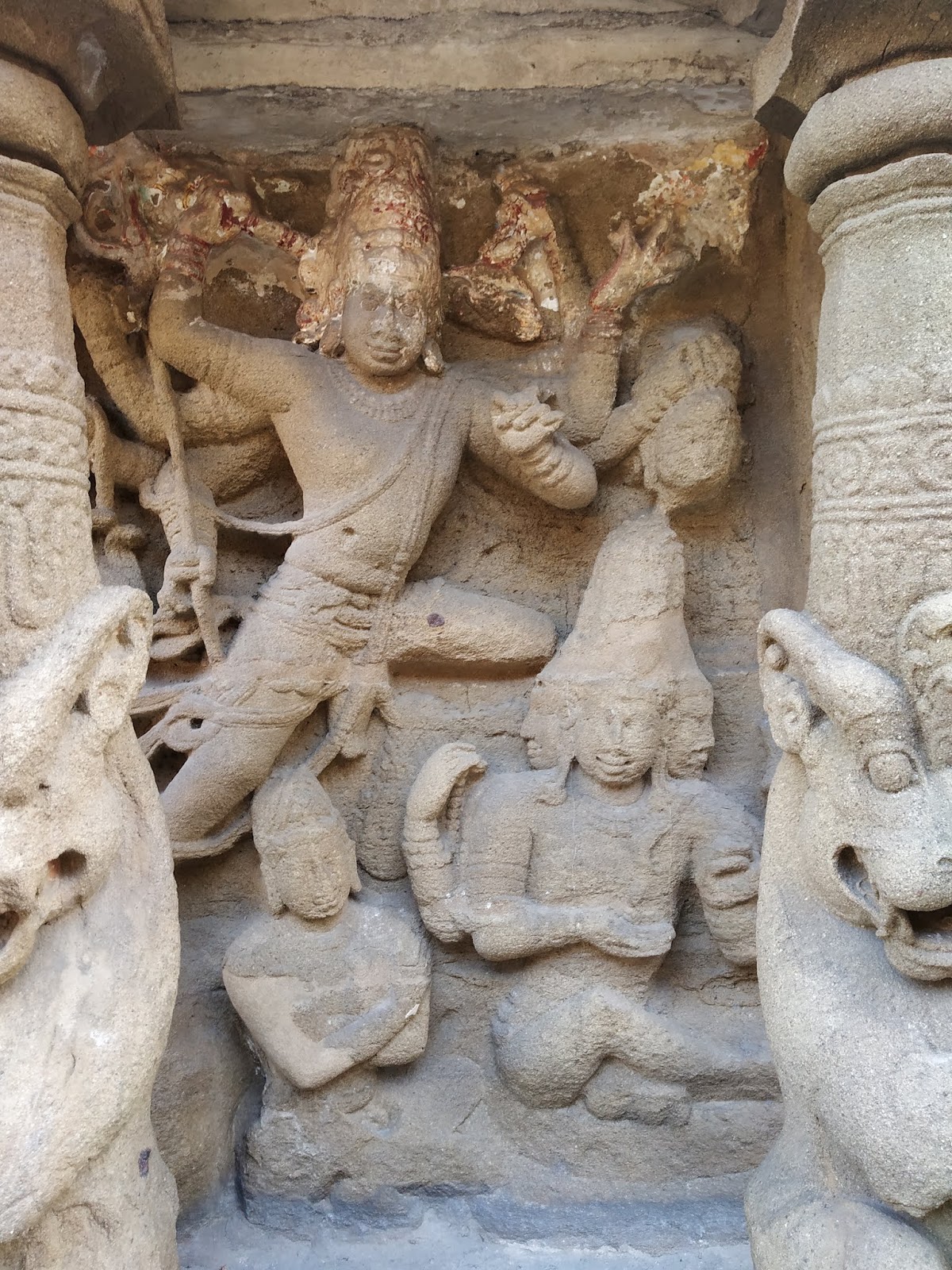
Grandeur of the Kailasanatha Temple, Kanchi

Three hundred years after the Kailasanatha Temple at Kanchi was built, a certain tourist visited the temple. He was bowled over. It was poetry in stone! He ordered for the measurements of the temple to be taken forthwith. With this, he rode back to his capital city. Such was his restlessness that he could not go back to his palace. His first priority was to find a piece of land and lay the foundation for what would be his temple....on the same lines as Kailasanatha; only it would be 9-times bigger and better! He was no ordinary tourist- He was King Raja Raja Chola!
And what he built was the Brihadeeshvara Temple at Thanjavur. They say copying or imitation is the best form of admiration. Raja Raja Chola's Brihadeeshvara Temple was copied.... a second time at Gangaikondacholapuram by his son Rajendra Chola.
When we think of the Cholas and their immense contribution to temple construction, Thanjavur and Gangaikondacholapuram are the first temples which come to mind. What we don't know is that the blueprint for these finest temples came from elsewhere- from the Kailasanatha Temple built by the Pallavas at Kanchipuram. And that too, a baffling 300 years before these Chola masterpieces!


Gangadhara
We are at the Kailasanatha Temple at Kanchipuram. This is the oldest standing functional temple at Kanchipuram. It is 1400 years old and built by the Pallava king Rajasimha Varma. His successor Nandi Varma built the Vaikunta Perumal Temple, also at Kanchi. These two temples are strikingly different from the other temples at Kanchi.
Till the time of Rajasimha Varma, temples were built as bas-relief works inside caves. We find such examples at Mahabalipuram and even elsewhere, like the Chalukya works at Badami.
Rajasimha Varma was a pioneer when it came to building a temple by stacking up boulders. He was a trailblazer, and temple-construction would never be the same again.


What greets us at Kailasanatha is the sheer grandeur- the scale, the richness in sculpture and the detail. The elaborate temple tower and the corridors are filled with panels- stone panels, each depicting an episode from the puranas. A casual visitor will likely miss them. You need a tourist guide. We are lucky to have the guide Narayanan. He makes the place come alive.


The sanctum sanctorum has a giant Shiva linga. It has 16 "faces", each face is a chiseled flat side. If an octagon has 8 sides, you double it and you get the 16-faced Shiva linga. A little tunnel runs from one side of the garbhagriha to the other side. There are steps to a point inside, after which you crawl your way out! It is dark and narrow and we have no volunteers to burrow through the tunnel!


Kailasanatha is dominated by Shiva in his various forms. Dakshinamurti, Ananda-thandava murti, Urdhva thandava murti,

Ananda-thandava
Lingodbhava, Gangadhara, Kiraata, Trimurti, Tripurasamhaaramurti....each one is a gem. Lord Vishnu's popular avatars find a place too- in samudra mathanam,  as Trivikrama and Narasimha. So does Devi as Durga. The 'ratna trayam'- Shiva, Vishnu and Devi dominate the sculpture-scape, but the focus is on Shiva at Kailasanatha. It is clear that the Pallavas of the time were equal devotees of Shiva and Vishnu as evident from these two temples- Kailasanatha and Vaikunta Perumal.


Not to be missed is this huge panel depicting King Rajasimha Varma and his queen Rangapataka. And the entry points to the temple flanked by two walls- one with the 12 Adityas and the other with the 11 Rudras. A couple of plain panels would have had paintings in the past- remnants of which are seen today....in greens and red….and with the partial image of Lord Vishnu. That is all that survives.


Poosalaar naayanaar and King Rajasimha:


The consecration of the Kailasanatha Temple was scheduled. The night before the event, Lord Shiva appeared in King Rajasimha's dream. Shiva said he could not be part of the ceremony the next day because he had another consecration ceremony to attend at Nindravoor by his devotee Poosalaar. King Rajasimha rushed to Nindravoor (to the North West of present-day Chennai) to see the temple which superseded his. To his surprise, he found there was no temple at Nindravoor. He searched out Poosalaar and reached his hut. That is when he learnt that Poosalaar had built an entire temple, brick by brick in his own mind! That day, was the consecration day planned for the 'maanasa' temple. King Rajasimha understood the supreme power of devotion- even emperors had to bow down!
Nindravoor became "Tiru-nindravoor" and Poosalaar is venerated to this day as one of the 63 naayanmaars. The story of Poosalaar is inextricably linked to the Kailasanatha Temple at Kanchi.


Muthuswamy Dikshitar has composed a couple of songs on the Kailasanatha temple. One of them is "Kailaasanathena samrakshitoham" in the raga Kambhoji, Shiva's favorite raga.
https://www.youtube.com/watch?v=VZ3n_2Kq8xE


Words are superfluous.  They can do no justice beyond a point. We leave you with these pictures. They can perhaps convey a little....a little of the sense of awe, wonder and absolute amazement we felt!
No doubt....this is poetry in stone!


Dakshinamurti
Lingodbhava
Arjuna fighting Shiva as Kiraata    


Dvaadasha Aadityaah
Ekaadasha rudraa
Saraswati (no veena but with book!)
Corridor


Indra trying to take on Shiva
And prevented by Brahma!


kaalasamhaaramurti


Shiva plucking off Brahma's head!


Kanchi Kamakshi

At the sannidhi of Goddess Kamakshi....
The darkness of the garbhagriha, the flicker of the lamps, the orange radiance spread all over....and bathed in that mellow light, the surreal image of Goddess Kamakshi!


Our thoughts race. Our mind turns numb. Just the immensity of this vision! Think about it- this is the same deity which Adi Shankara saw a thousand, may be, two thousand years ago! This is the same idol which Muthuswamy Dikshitar saw two hundred years ago. And in this march of time, spanning centuries and millennia, how many kings and emperors, musicians and artists, saints and Shankaracharyas, devotees and common-folk would have sat just like us.....on this very floor, and beheld this very deity....this Goddess Kamakshi!
If we had any specific prayer for the Goddess, forget it! Either it does not come to mind or even if it does, it seems too trivial to ask! It's as if we are on top of a mountain peak; from that height, everything in the valley down below is just a speck, a tiny little dot!


As per Paramacharya, the name 'Kamakshi' can be looked in two different ways:
She is the one who has Kaa (Saraswati) and Maa (Lakshmi) as her very eyes (akshini). As per this interpretation, Devi, Lakshmi and Saraswati are not separate deities, but indeed, One composite Being.....with three different aspects. The interested reader can look up the verse "giraam aahur deveem" from the text Saundaryalahari.


Another way of looking at Kamakshi is the one whose sidelong glance gave a fresh lease of life to Kama. The story of Kama, i.e. Manmatha is well known. After Shiva burnt Manmatha to ashes, Devi takes pity on Rati, Manmatha's wife and restores Manmatha back to life with just a glance. Hence, the name Kamakshi.


In the moments available, we try, try ever so feebly, to drink in....the image of the Goddess.
On her crown is the digit of the moon....sparkling! Both Lord Shiva and Kamakshi hold the "third-digit of the moon" (triteeya) . It is said that Shiva and Shakti are similar in several ways.  They are similar in name- He is Shivah, She is Shivaa. They are similar in features,  He has three eyes, so does She. And when it comes to ornaments, He has the moon ( triteeya chandra-kalaa) on his head, so does She (kalaabhyaam choodaalankrta).


Our eyes rest on Kamakshi's eyes. We are reminded of Dikshitar's song "kanja-dalaayataakshi" on Goddess Kamakshi- The one who has lotus-petal shaped eyes.
As Kamakshi, she holds the same weapons as Kamadeva. Her right hand holds five arrows made up of flowers and her left hand holds a bow made of sugarcane, exactly like Manmatha. It is as if, under the sway of Manmatha, we fall a prey to kama, to desire; but when we surrender to Kamakshi, the very same weapons become a source of blessing for us.
Dikshitar says the same in his song- "rakshita madaney". She protected Madana, i.e.Manmatha….and through that, she protects all of us from Madana's snare.
The other two hands of Kamakshi hold the pasha i.e. noose and the ankusha i.e. a tiny spear. With the pasha, she takes care of our binding-likes. With the ankusha, she pierces our binding-dislikes.


Unlike other deities, Goddess Kamakshi does not hold her hand in "abhaya mudra" (protection gesture). Adi Shankara nicely says that what protection other deities offer through specific "abhaya mudra", Kamakshi does casually, through her very feet!
Dikshitar, in his song "kanja-dalaayataakshi" says the same. He describes her feet as "manjula charaney" and immediately says "maamava"- may the Goddess's feet protect me!


 Sitting at the sannidhi, we see the parrot perched on Kamakshi's hand. More lines from Dikshitar's song come to mind. He says Kamakshi is "shiva panjara shuki".
If Shiva is the cage (panjara), she is the parrot (shuki). It's as if in the cage of Shiva's heart, Kamakshi is forever lodged....never to fly away! This phrase is significant because outwardly, at Kanchi, it looks as if Shiva and Parvati are staying in separate temples since there is no shrine for Devi in any of the Shiva temples! Still, she is shiva-panjara-shuki.


Finally, Dikshitar says she is "ekaamresha griheshvari". At the Ekaamreshvara Temple in Kanchi, we do not have a shrine for Devi.  Still, Ekamresha, i.e. Shiva and Kamakshi are inseparably one.


As we head out of the sannidhi, the dazzle of the sun makes our eyes squint. The white gopurams flank us on each side. We walk around the temple-tank and head out of the temple premises.


Kanchi may have divisions of Shiva-kanchi, Vishnu-kanchi and Jina-kanchi, Kanchi may have temples for Shiva and Vishnu, but one thing is entirely clear. The focus is on Kamakshi! It is ultimately a shakti peetham. Adi Shankara asked the Chola king to redesign Kanchi city into a giant Srichakra…..with 44 triangles....the centre of which is the bindu….and in that bindu...stands Goddess Kamakshi.
If the whole world is bhumi-devi, Kanchipuram is her naabhi, her navel. And on her navel, she wears a girdle, a kanchi-daama. It's as if the whole of Kanchipuram tinkles with just one sound....the jingling from the mekhala, the mani-mekhala, the girdle.... of Goddess Kamakshi!
We are blessed today!


Dikshitar's kanjadalaayataakshi in the raga Kamalamanohari sung by MS Subbulakshmi.
https://www.youtube.com/watch?v=VjJ7fPKL_Sk


Saturday, 29 December 2018

Ekamreshvara Temple at Kanchi

The 'pancha bhuta sthalas' are well known in South India. They are a set of 5 temples dedicated to Lord Shiva. In each of them, Lord Shiva is worshipped as one of the 5-elements. At Kanchipuram, Lord Shiva is worshipped as the very 'earth", at Tiruvaanaikaaval, as "water", at Tiruvannamalai as "fire", at Kaalahasti, as "air" and at Chidambaram, as "space". Shiva exists in and as the five elements in the universe.


We are now at Kanchi!
Ekamreshvara Temple in Kanchipuram is the prithvi kshetram, where Shiva is visualized as the "earth" principle. As Krishna says in the Geeta, "punyo gandha prithivyaan cha"..."I exist as the very earth, with its special quality of fragrance (gandha)". 


The sthala puranam associated with this temple is interesting. Once upon a time, in a momentary lapse of discretion,  Parvati playfully covers the eyes of Lord Shiva.  When Shiva's eyes close, the entire creation comes to a close! To atone for this unintentional error in judgement, Parvati comes down to the earth. She reaches Kanchipuram, creates a sand lingam under a mango tree and propitiates Lord Shiva. River Kampa is in flood. Parvati embraces the sand lingam and protects the linga. We see this incident depicted in the temple. It also finds a mention in the Periya Puranam while describing Ekaamranaatha.


Pillar with Parvati playfully closing Shiva's eyes!


Parvati protects linga from the raging waters of the Kampa River


Hence, the name Ekamreshvara for Shiva in this temple. Fragrance of mango is special. It is fitting that the principle of earth, with its special quality of fragrance (gandha) is associated with the mango tree.


A pillar inside the temple beautifully captures the sthala puranam. A mango tree inside the temple premises lends credence to the above story. It is said that this mango tree is unique. It has 4 main branches signifying the 4 vedas. The fruit hanging off from each branch is supposed to have a different taste! We are reminded of the Geeta- "chhandaamsi yasya parnaani". If the universe is considered as a giant tree, the leaves (parnaani) on each branch (shaakhaa), which keep the creation going, are the Vedas (chhandaamsi).
As we walk up to this tree and climb up a short flight of steps, we see the idols of Shiva and Parvati. We can take a pradakshina around this tree.


Mango tree with the shrine for Shiva and Parvati


Not to be missed is the glass-case housing a 3500 year-old trunk of the earlier mango tree. It is partially covered in a silver casing with the image of Parvati embracing the shiva-linga embossed on it.


There are no sannidhis for Devi at any of the Shiva Temples in Kanchi. She stays as Kamakshi, all by herself at Kamakshi Temple. At Ekamreshvara too, there is no sannidhi for Devi.
The gopuram is gigantic and looms tall and majestic. From the highway, when we take a turn into Kanchipuram, the gopuram which hits the eye is Ekamreshvara's.
The temple is huge and it takes a while to cover the entire premises. The sculptures on the pillars are exquisite- chiseled to perfection. The temple pond with its limpid waters and bordered with lush-green vegetation takes our breath away.


The story of Kamakshi does not end here. She proceeds to Arunachala, Tiruvannamalai and Sage Gautama expounds Shiva's glory to her. Thus, the prithvi kshetram and the agni kshetram are linked through this sthala puranam.


The temple pond


Dikshitar's pancha-bhuta kshetra kriti:


Muthuswamy Dikshitar has composed a kriti at each of the pancha-bhuta kshetras. We  find interesting details in his compositions. For this kshetra, he has composed the kriti "chintaya maa kanda moola kandam" ("Reflect on that Lord at the foot of the mango tree") in the raga Bhairavi.
Moola in Dikshitar's song can be taken as "root" also (instead of the foot). The Lord is indeed the root of the tree-of-creation. We see this in the Geeta- "urdhva moolam" (where urdhva refers to the Lord who exists as the root of the creation). It's as if the ashwatta vriksha (peepul tree) imagery in the Geeta has been replaced by the mango-tree at Kanchipuram's Ekamreshvara. And at the root of this mango-tree-like-creation, is the eternal couple "Parvati-parameshvarau". We can look at it this way too.
As per the musician Vijay Siva, it is apt that Dikshitar has chosen the raga Bhairavi. His reasoning is the following- At Kanchipuram, Shiva and Parvati reside in separate temples. It is as though they are cross with each other, as if she is "bhairavi", in ugra rupa at Kanchi!


While in the other kshetra kritis, Dikshitar explicitly mentions Devi, in this kriti alone, he stays silent, in keeping with the story at Kanchi.
However, he weaves in Devi into the kriti deftly by embedding the name of the raga in the kriti. He says "bhairavi prasangam" (united with Bharavi). In addition, in this kriti, Shiva is called "somaskanda"- "sa uma skanda", the one who is with Uma (Devi) and Skanda. Thus, inwardly, Shiva is forever united with Uma, with Bhairavi.


The result for worship at this kshetra is stated by Dikshitar. He says it is saamraajyam. When we worship the Lord as "earth", the reward is also gain of the earth- prithvi saamraajyam now...and moksha saamraajyam later.
The interested reader can look up this composition.
https://www.youtube.com/watch?v=-99FSoIHWlY


So....when are you making your trip to Ekamreshvara? Let us start.....and now!!