Friday, 16 October 2026

On Fevicol!

As part of the "Golu" celebration during Navaratri, there is always some cut-and-paste job to be done. This time, it was a picture that had to be stuck on a cardboard to serve as a backdrop for the golu idols. That's when "Fevicol" came out of the shelf. If there is one common factor...that runs...in and through life's most fun moments, it is Fevicol. Who can forget those umpteen science projects when we were in school? And a re-run of the same projects, yes, this time with our kids! Fevicol was that constant companion- kal bhi...aaj bhi...kal bhi! 

Back in the day, as kids, Fevicol began with its share of edgy moments. Apparently, before Fevicol, there was some bloke called "Araldite". Grandparents were forever calling him Araldite- "Get that Araldite. I need to fix this broken cup!" You felt like responding emphatically, "Grandpa! There is no Araldite at home. No Araldite! Only Fevicol!" Thankfully, I never saw this Araldite fellow. Had I seen him, I would have punched Araldite's nose, for trying to steal the thunder from my Fevicol! 

They say an elephant's trunk is the most versatile instrument- the trunk can pick up a needle, the trunk can uproot an entire tree. Fevicol can rival that versatility and more! You stuck postage stamps on an envelope with Fevicol. And when a  shiny, sun-mica sheet had to be stuck on the wooden wardrobe, the carpenter reached out for...well....Fevicol!

During high school, we had our share of challenges. One fine day, billboards and advertisements screamed- "Fevicol is now Movicol". Araldite was bad enough. And now Movicol. Who is this Movicol? Why is he here? What happened to my Fevicol? Had we known Jantar Mantar back then, we would have surely protested. Without Fevicol, life lost all cheer. Like Guru Dutt, for an entire year, we wallowed in sadness- "Yeh duniya agar mil bhi jaaye...to kya hai!"

And then, the miracle happened. Apparently, no one accepted Movicol in the market. We knew it! Fevicol made a grand re-entry! Life was rosy once more! Guru Dutt,  his black shawl, his sad song....everything vanished.  With Fevicol, life was "Eena meena deega", lively and effervescent...once more! 

Part of Fevicol's allure lay in its unique fragrance. Like Amrutanjan, you knew it was a Fevicol home, the moment you entered it. It was unmistakable. When the tooth filling came off from the cavity and you rushed to the dentist, you felt like asking him, "Did you use that Movicol chap by any chance, doc? Can you use Fevicol...at least this time doc?" When friends moved closely, you made a sly remark, "Look at them- stuck like Fevicol!"

In some ways, Fevicol was unforgiving. When you applied Fevicol to the back of a paper and had to stick it to a piece of cardboard, you had only one chance. Even life gives a second chance, but not Fevicol. There was no scope for alteration- having stuck the paper horizontally, you couldn't change your mind, and stick the paper back vertically. You felt as helpless as Vibhishana. In a moment of indiscretion, the idol of Ranganatha was kept on the ground at Srirangam.  The idol stayed stuck to the terra-ferma for good. Vibhishana could never carry the idol back to Lanka. I bet....it must have been Fevicol! 

Fevicol was too finicky. Sometimes, the paper smeared with Fevicol...stuck to itself, before you could place it on the cardboard! That's it! It was now completely ruined. Too much Fevicol made the paper look wrinkled and unsightly on the cardboard. Too little Fevicol made the ends of the paper curl up like dog-ears, from the sides of the cardboard! Couldn't Fevicol be a little flexible, a little...may be?

This golu, the cardboard picture backdrop was finally ready. My fingers tips were shiny, white and wrinkled, yes, with solidified Fevicol.  I spent the next half-hour pealing the Fevicol off, strand by strand. That's when all the above lines came to mind. 

There was just one song on my lips- from the Bollywood film Dabangg-2- "Chipka le saiyaan Fevicol se"!!!


Friday, 9 October 2026

What if you cannot dance?

An all-important component of a modern, Gen-Z Indian wedding is "sangeet".  It does not matter if it is a North Indian or a South Indian wedding. Sangeet is non-negotiable. For the unversed, sangeet is not your "kalyaana kutchery" of yesteryears where Semmangudi mama regaled the wedding audience with a nuanced rendition of Bhairavi raagam. No! Sangeet now...is more about dance than music. A DJ plays assorted film music, that blares over the speaker at an intolerable decibel level. Everyone joins the dance-floor. It is a loose, free-for-all, dance-as-you-please format. The bride, the groom, the Gen-Z attendees, the young, the old, the kids, the Gen-Jurassic- almost everyone lets his or her hair loose and dances as though there is no tomorrow.

The problem is for the outlier- what if you cannot dance? The outlier sticks out like a sore thumb, unable to join the revelry. He stands squirming in a corner, arms tightly folded across his chest, nervously gritting his teeth and watching the unfolding spectacle. He cannot quit and go home for that will be rude and discourteous. He cannot join this dance equivalent of "kumbal-oda-govinda" for obvious reasons- he cannot dance. Silently, he prays that he should be spared from this agony- that these sangeet hours should melt away in a second. Tough luck! "Appadi podu podu podu" song is over....only to be replaced with "lungi dance...lungi dance"! The audience loves it- they dance as though possessed by some spirit at a Bhuta-Kola. Even the Mahabharata may end after 100,000 verses but not sangeet. 

Matters get worse. The outlier is not allowed to stand in a corner anymore. "What do you mean you cannot dance? Just dance man! Just give it a shake man! Groove...this way!" Sometimes, he is bodily dragged, at times lifted, right into the dance ring! Like a mortally scared goat that digs its heels at the prospect of imminent doom, he recoils and resists. If the outlier had had his way, he would have added his name to the hashtag Me-Too movement for gross, physical violation! The outlier now finds himself right in the middle of the dance ring. Around him, the adrenalin is flowing in torrents- hands, legs, hips, heads all gyrating. What do you do now? "Abhimanyu....chakra-vyuuh mein phas gaya hai tu" that's the only song that comes to his mind! How does he get out of this? Spare a thought for the outlier- the only coordinated activity with hands and legs that he has ever been a part of, is the PT left-right-left "march-past", way back in high-school. 

The exit strategy is simple. Never stand in a corner doing nothing. That will brand you as boring, uptight and a party-pooper. You need to "look" interested. That's enough! Use your mobile-phone and pose as though you are recording the dance proceedings. You move from one vantage point to the other, displaying your mobile prominently. You needn't even switch the video on. After all, how many Gigs of data can your measly cell-phone store? Just move around, with a smile on your lips, and a thumbs-up sign to whoever makes eye-contact with you! That's it! The technique works like a charm. It has bailed me out...100% of the times. 

This dancing requirement has gone out of hand. There is no escape. Like CPR, it has become an essential life-skill. The school curriculum needs revision. We need a new subject- not that Bharatanatyam "thai ya thai" drill silly, it should be Bollywood-dance-101, starting from "Kajra re" and going all the way, till you can dance to "Naatu Naatu" with elan!

They say, learning has no age. We hear about "bathroom singers"- those who are afraid to face the public but confidently howl, completely out of tune in the confines of the bathroom. We will soon have a new breed called "bathroom dancers"! Hear that loud music and the stomping of feet behind that closed bathroom door, as though the floor and 4 walls are about to collapse? That's me..."Left leg aage aage..right leg peeche peeche....! Hrithik Roshan, Allu Arjun, NTR Jr...move out the way! I am coming!


Friday, 2 October 2026

The Great Bannerghatta Road

For over 20 years now, I have been going up and down Bannerghatta Road. It has become so much a part of me, that it is not just another road. It is my connect with civilization. History books talk about Chandragupta Maurya- how he built the Grand Trunk Road connecting Takshashila (modern day Pakistan) to Pataliputra (modern Patna, Bihar). Bannerghatta Road may not have such high aspirations. However, in its own humble way, it runs North-South, straight as an arrow, cutting through vast swaths of the city of Bengaluru! 

They say- one should never probe into "rishi-mulam" and "nadi-mulam". "Road-mulam" should be added to this list. Learn to trim your curiosity when it comes to the origins of a rishi, a river or even a road! The Ganga flows through sub-terranean caverns and makes its first visible entry at "Gomukh". It is hard to imagine that this little mountain stream at Gomukh cave, the size of an oversized cow's mouth, will grow to be the mighty river that we associate it with. 

So too, with Bannerghatta Road. Close to the zoo, it is but a tiny, nondescript, piddly lane. But don't you take it lightly, as though it is just bland "idli"! It is not! Slowly, but surely, as it covers more ground, the road swells in girth, and by the time it hits Jayadeva Circle, it has grown to those monstrous proportions that we know this great and mighty road to be! Like the roar of the Ganga at Rudraprayag, the cacophony of traffic has risen to its peak. It is here that you feel like pumping your fists in the air, the forehead veins throbbing with emotion, with full throated shouts of "Har Har Bannerghattey! Har! Har!"

The Ganga has numerous names- Bhaageerathi and Jaanhavi to name a couple. So too, with this road. Some call it affectionately "banneru"-ghatta. For others, especially when they run out of space, while filling those forms, it is as simple as "BG Road". The similarity with Ganga doesn't end there. If Prayag's Triveni sangam is Ganga's crowning glory, for Bannerghatta, it is its triveni sangam towards BTM. (For the unversed, BTM stands for Byrasandra, Tavarekere and Madiwala, some of Bengaluru's sprawling townships). 

Ganga is a perennial river. You guessed it, Bannerghatta is a perennial road. There is no time, when it is traffic free. Even at 2am, it maintains a steady flow. And when it comes to peak hour, it is verily a wild river! The glacial bunds are broken, the traffic is let loose; it flows in torrents, covering the road and more, till even the footpaths are taken over by the two-wheelers! Caught in one of those traffic deadlocks at a junction, with intertwined criss-cross traffic, it's exactly like getting sucked into Ganga's treacherous whirlpools. Extricating yourself from the crocodile-like traffic grasp requires divine help, the kind...the elephant Gajendra got! For Ola, Uber and other taxi drivers, even mention of the name- "Bannerghatta" is like simha-swapna- they quake with fear! "Bannerghatta? I will not come come! Baralla Saar! You get down saar! Bannerghatta baralla saar!" 

It is said- blessings from the river Ganga, is gained in a 3-fold way- by mere sight (eekshanam), by using words of praise (stotram) and by dipping oneself in the water (snaanam). Bannerghatta blesses in much the same way- you see the traffic, you talk about the traffic, and finally, you immerse yourself in the traffic!

Many an attempt is made to tame a ferocious river by constructing dams and canals.  But, what about this road? Presently,  the metro pillars are all up, the stations are ready, even the trial runs have completed many sorties. "The metro is about to start"- we've been hearing for months now. Can an unruly river be tamed...ever? We know...a river always has the last laugh. Can this mighty road be tamed? Time will tell! 


Saturday, 26 September 2026

Two fistfuls of coins!

 A couple of months ago, we had to make an offering at our village temple. The stipulation was straightforward- my daughter had to take a fistful of coins in both hands and make the offering to the deity. The day prior to the temple visit, I tried to procure these coins- just enough to fill those tiny palms.

It may be easier to stumble upon a Gupta Age coin by digging the ground, but there are no modern India coins anymore. Even beggars have moved on. Rummaging through the closets and shelves at home, I found no coins. If at all a coin peeped through the rubble, it was either an American cent or a Dubai Dirham stuck from a previous trip. It was unclear if the village deity accepted foreign currency. 

Thereafter, I tried the neighbourhood shops- small tea shops, paan-outlets, grocery stores, and of course malls. The reaction was the same from all shopkeepers, "Sir! This is UPI age sir! This is AI age! Coins? Coins? Are you a relic from a previous Stone Age?" Desperation increased by the hour. How are we going to get these coins, that too, two fistfuls? Sticking out a 500 rupee note at each shop, I tried to plead my case, even if it was a bad bargain, "Do teen coin de de baba, aap ke baal-bachche khush rahenge! Do teen coin de de baba...!" Thankfully, some good Samaritans obliged and saved the day.

We are yet to uncover the long-term consequences of this coinless age. It has not sunk in completely. Take Cricket. How will the two captains start the game if there is no coin to toss? The romance of Cricket will be totally killed without the toss ritual. Coins gave wealth a fitting imagery. When Tenali Rama retorted with a witty answer, the delighted king rewarded him with a bag of coins. It made an impact. Imagine if Krishnadevaraya said- "Nice answer Tenali Rama! I will now make a UPI transfer to your account! It just wouldn't cut it, would it? When Bhadrachala Ramadas was imprisoned at Golconda Fort for siphoning away the Nawab's money, Rama and Lakshmana appeared in person and returned the money in coins. Those coins are still available. Imagine if Rama had to ask for the Nawab's UPI ID! Adi Shankara pleaded on behalf of the poor lady, who had nothing to offer, except an overripe gooseberry. His prayer melted Goddess Mahalakshmi so much so She rained coins for an entire muhurtam (48 minutes). No such miracle is possible anymore. Magicians are also an impoverished lot- those tricks centred on materializing coins, and getting them to disappear, in the blink of an eye, are suddenly irrelevant. 

As children, coins were a constant companion. Every child carried a "piggybank". Each time it inserted a coin, earned from a guest's good-will,  the child's eyes twinkled. It visualized a future- a future where these jingling coins would swell and multiply in the pig's belly, so much so, one day, the entire room would be filled with its choicest toys! Will a UPI transfer give the child a similar kick? At school, Sridhar made some of the most innovative sketches in his drawing book. Placing a coin underneath the paper, he vigorously stroked the pencil over the paper. Soon, the coin came alive- complete with its denomination and peripheral designs. The solar system in the geography note-book could never have been drawn without coins. The 1-rupee coin was always the sun, the 25 paise coin was the earth. 

With the depletion of coins, life has been robbed of all dramatics. Back then, life's greatest decision, "to be an engineer or a doctor", was made by flipping a coin. Bollywood's biggest blockbuster "Sholay"- its entire plot centred on a coin, a double-headed coin, a secret that was revealed at the end of the film. Try using the UPI idea for Sholay- it will fall flat, with mud all over its face! And what about those tacky expressions in English, "Heads I win, tails you lose!"? 

Thankfully, every dark cloud has a silver lining. As a youngster, the topic on "Probability" in Mathematics was my eternal bugbear. "If I have 3 coins and I tossed them, what is the probability, that I will get 3 heads?" What kind of a question is this? I pondered over this question endlessly. It just didn't make any sense. I felt like answering, "It depends on the person, how lucky he is! No?" What else can I say?

Thankfully, we have moved on....moved on from coins to UPI. The world is a better place. There are no coins, no heads, no tails, and surely, no more Probability questions. 

Saturday, 11 October 2025

The Platform Ticket

The traffic in our metros is such, no time-estimate can be accurate. If you need to reach the railway station, it does not matter how early you start. You will still be scampering to board the train, and will barely make it, minutes from the train's departure. 

Sometimes, you are not travelling but have the onerous responsibility to assist a relative to board the train. The ride to the station is nervy. You assure your relative, "Don't worry! We will surely make it! We still have 30 minutes! This traffic jam will clear up very soon!" By now, the relative has given up and looks at you with total mistrust!  

It is a nail-biting finish. Tension is writ large on the face...the moment you reach the station. You must quickly spot the platform number from the overhead display. And then, make that 100 metre dash...yes, with the relative in tow, along with the pieces of luggage! In this overwhelming commotion, one vital point is completely missed- buying a platform ticket.

The train leaves- the rear of the last compartment melts into the horizon. It is now...it is now...that the platform ticket comes to mind. How did you miss it? How do you make your exit now? 

The mind comes up with some brilliant suggestions. One part of the mind behaves like Raja Harishchandra, "Dude! Just go straight to the ticket-collector and confess. Tell him clearly- I forgot to buy the platform ticket. Punish me!" The other part of the mind is practical, "Don't be silly! You cannot be so idealistic in this day and age! Be smart and plan your way out!"

Planning your way out when you are guilty is not easy. The guilt is written all over the face. The eyes are shifty, like a prisoner who has just emerged from a daring jailbreak. You look this way and that....to check if any ticket-collectors can be spotted. Every human face looks like a prospective ticket-collector, about to nab you by the ear, sporting an evil grin. "You thought you could be over-smart and beat the system, did you? The arms of the law...are long and inescapable, my dear! Kaanoon ke haath...!" he trails away.

Fear takes over. A shiver runs down the spine. You shuffle your feet to the over-bridge at the platform. You check over your shoulder every few seconds, "Is someone watching? Is someone watching?" By now, a dog on the platform is alerted. Dogs can smell fear. You feel as though...not just this dog, rather, the entire pack of dogs, from all the platforms, are gunning for you, and they will collectively hand you over to the ticket-collector! 

The mind comes up with an alternate approach, "Relax! Pretend as though nothing has happened. Be bold! No one will suspect you do not have a platform ticket. You can fake it and make it!" You take a few deep breaths and go for a complete makeover. You force your face to relax and wear a hint of a smile. You brush your hair back with a flick of the fingers. You roll up the sleeves. The palms go into the trouser pockets. Some self-advice is always good, "Walk with an irreverent, confident, swagger. And perhaps, even hum like Dev Anand- Har fiqr ko dhuen mein udata chala gaya! Who is going to suspect now?"

The railway platform dog is now thoroughly confused. His ears prick up- he has never seen anyone happier! After all, no one whistles and sings merrily, with such abandon, at a railway station. He comes up the over-bridge stairs, following closely at the heels. If the dog is suspicious, what chance do you have with the ticket-collector? None. Once look, and he will catch you by the ear! 

You quickly scan other exit strategies. What if you cross the tracks on foot, from platform-7, and can get to the railway gate? One jump, and you will get to the road. But...but.. is it safe to cross the tracks? Ok! How about pretending that you are not an escort, but a traveller who has just alighted from the train? That should work, shouldn't it? But...but...the lack of any luggage in hand...will be a definite giveaway. 

The last resort was to "prop up a Shikhandi". For the unversed, Shikhandi was a soldier in the Mahabharata war. When Arjuna could not face Bheeshma, he used Shikhandi as a shield. He propped Shikhandi upfront, hid at the back, and faced Bheeshma. This method should be effective. You go with a crowd of people, stick to them closely, but behind them. While the collector is busy checking the platform ticket for someone, quietly, unobtrusively, slip away! No fuss, none whatsoever! In Tamil, this is called the "Kumbal oda Govinda" strategy. It works all the time. What if you still get caught? You chide yourself, "Shut up! There is nothing in life...that is risk-free. Some calculated risks must be taken!" 

The over-bridge walk was a never ending one. I stuck close and mingled with a motley crowd of passengers, on their way out. Suddenly, the walk ended in the open. The sky was blue, and the sun came down, nice and hard. There was no ticket-collector anywhere! 

Some worries...have unexpected, simple endings! Har fiqr ko dhuen mein udata chala gaya!

Saturday, 27 September 2025

The inflatable pillow!

In this age of Artificial Intelligence, we have seen some life transforming inventions. We totally agree. But mind you, every generation had its own inventions that took the world by storm. One such invention was the "inflatable pillow". It made overnight train journeys an absolute pleasure. Much like one would flaunt an iPhone today, back then, your status symbol was defined by carrying an inflatable pillow. It was your priced accessory.

Before this novel invention saw the light of day, life was not easy- you had to carry your personal, oversized pillow from home. The pillow was stuffed in a "hold-all" and lugged into the train coupe.  And when it was time to sleep, the hold-all was unwrapped on the train-berth.  The hold-all body served as the cushion, and the bulbous pillow was the headrest. 

That's when the "inflatable pillow" made its grand entry! Suddenly, you didn't have to carry your pillow from home. It was replaced with a sleek, petite inflatable pillow. It looked like an oversized handkerchief- a piece of canvas, that could be carried easily. But this little, diminutive fellow was a pocket-sized dynamite when it came to utility! At one corner of the cloth, was a tiny aperture, fitted with a plastic cap. You blew into the aperture. With each puff, you watched it grow like a balloon. Soon, your pillow was ready!

Stretching yourself on the train-berth, with this pillow as the headrest, you stared at the overhead, grilled fan. The steady rattle of the rail and the rhythmic rocking lulled you to sleep. Needless to say, it was a pleasure like no other. You owed the experience entirely to the inflatable pillow.

Inflatable pillows had a quirky sense of humour. Sometimes, you blew your lungs out, but the pillow wouldn't budge. It stayed flat and stubborn like a rebellious  child. Totally breathless, you examined the sides of the pillow, only to find a tiny incision. Yes, a safety pin left carelessly open in the suitcase, had done the deed- it had successfully managed to burrow a pin-hole into the pillow! Now, the pillow was as purposeful as a punctured bicycle tyre!

Inflating this pillow was no mean task. It required the power of a Naadaswaram artiste. The cheeks were full and puffed, the forehead veins throbbed, the eyes bulged, the ears went red- all of this...all of this...to gather that lung-power to pump the next bout of air into the pillow. It was hard work.

Sometimes, after expending your entire energy in inflating this monstrosity, towards the end, you fidgeted with the cap and struggled to close the vent in time. The pillow punished you mercilessly for your clumsiness. By the time you got your act right and managed to plug the aperture, the pillow had deflated to its original, flat, 6-pack self! The hard work was now completely undone and you had to start from scratch! 

At times, your fingers lost control over the inflated pillow, while trying to plug the cap. It was now a free spirit, much like a run-away balloon. It darted across the coupe like a meteor across the sky. You ran after the meteor and retrieved it...in the process, providing ample, comic relief to the co-passengers.

All said and done, an inflatable pillow had some serious weaknesses. Once inflated, you were never satisfied with its shape, size, feel and comfort. There was always some "room for improvement" much like the advice you hear in parent-teacher meetings. If the air was too full, it bounced about ungainly and summarily threw your head out when you pressed yourself against the pillow. If the air was less, it felt as though your neck had no support. Getting that right balance was an unending battle. Often, you spent the entire night blowing hot and cold- till eventually sleep took over...and you slept...regardless of the pillow!

Inflatable pillows had a strange fragrance that hung around them...all the time. It was tough to classify the smell as pleasant or unpleasant. May be, it was the musty odour of the canvas. May be, it was the excess saliva, may be, it was the smell of that plastic cap. Perhaps, it was just the fact that it stayed in the closet for months on end, and brought out, only when it was time for the annual summer vacation! 

Nonetheless, the inflatable pillow was your faithful, travel companion. What would I not give...to get those days back?...to lie down on that train berth, with that blue, inflatable pillow as headrest, to stare at that grilled, ceiling fan, and to hear that TT's voice, "Yes, the train is late by 2 hours. We are yet to reach Cuddapah. It will reach Renigunta only at 3 am. You can sleep till then!"

Saturday, 9 August 2025

Gems from the acharya: On Lord Vishnu

Continuing our study on the Harikatha by Smt Sharada Gannavaram, we are now going to focus on the 6th and final deity in the Shanmata (6-deity) pantheon- i.e. Lord Vishnu.

As mentioned in the previous articles, this harikatha is unique because all the verses are taken from compositions by the 34th acharya of Sringeri - Sri Sri Chandrashekhara Bharati mahaswami.

In this essay, we will see 3 verses by the mahaswami on 3 aspects of Lord Vishnu- as Lord Narasimha, as Krishna and as Rama.

Verse 1: On Lord Narasimha

The Narasimha parvata at Sringeri is sacred. The acharyas of Sringeri visit this mountain peak from time to time and offer prayers to Lord Narasimha.

In this verse, the mahaswami shows his intense yearning to visit this mountain. He says, "O Narasimha, kadaa tvaam pashyeyam...When will I see you?  When will I be present at that sacred mountain...pravara giri shringa sthitam aham?" What does acharya want to do, having reached that spot? He says, "I would like to sit there and do your mantra japam...tava manu japam kartum uchitah".

The longing continues in the next line. He says, "kadaa sat-chit saannidhye...When will I be immersed in your divine presence? When will I be in your saannidhyam...such that all the divergent thoughts can be gathered...and focused on you....vishama vishaya aasakta hridiram....sadaa saktam kuryaam?" These words are addressed to Lord Narasimha, who is extolled as the one destroys the cycle of birth and death..."jani-mrti harey....hey nara-harey".

This verse is similar to Adi Shankara's verses in the Shivananda Lahari, where he expresses the same yearning, in similar words- "When will I see you at Kailasa (kadaa vaa kailaase), where the happiness is so intense that even yugas and kalpas pass off...as though in an instant (kshanam iva)?" Similarly, Adi Shankara expresses the same longing in Saundarya Lahari for Devi...where he uses the same  "kadaa" construct..."When will I get the opportunity to worship your feet..."kadaa kaaley maatah...kadaa dhattey" etc.

Spiritual progress is measured in terms of the intensity to reach the goal. That burning aspiration, that anguish...as though the hair is on fire...and we need instant relief...is expressed through the repetition of "kadaa...kadaa...kadaa"...when...when...when? We see that extreme intensity in these verses.

In the Harikatha, this portion is sung in "Aahiri", a raaga used to portray "yearning" and "longing".

Verse 2: On Lord Krishna

The mahaswami has composed a sweet verse on Krishna as a baby, baala-krishna. We are familiar with Krishna and the adorable stories centred on butter. He is after all the "navaneeta chora", the one who steals butter. 

Poets and composers use their rich imagination to describe these butter episodes in interesting ways. For example, Muthuswamy Dikshitar, in his composition "Cheta shri Baalakrishnam bhajarey" (Dwijavanti raaga), says, Krishna has been eating so much butter, that when you go close to him, his face itself exudes the fragrance of butter! We see this in the line "navaneeta gandha vaaha vadanam"!

The mahaswami lets his imagination loose in his verse on Lord Krishna. He says, in the Vedas (in the Chandogya Upanishad section), it is said, that the "food that we eat" (annam) consists of 3 parts. The "gross part" of the food caters to the tongue alone and is ejected by the body. The "middle part of the food" nourishes the physical body. And finally and most importantly, the "subtle part" of the food, becomes the mind. The mahaswami expresses this point in the words- "annamayam maanasam iti shruti ukta". At this point, the mahaswami expresses surprise, that only now (adya), he understands what this message in the Veda means (shruti ukta arthah anvabhaayvam adya)!  He says, this statement in the Veda, that the subtle part of the food...becomes the mind of the person, is seen in Lord Krishna! 

Note- The term "mind" and "heart" are used interchangeably in scripture. "Manas" is the "hrdayam" and hrdayam is manas.

The acharya says, Krishna has been eating so much butter...that the "subtle part of butter" has become Krishna's mind. Butter is soft, the subtle part of butter, must be softer. And Krishna's mind, being the subtle aspect of butter, must be softest! Hence, he ends the verse, by saying...compared to butter also, "tasmaad api" komalam hrdayam...Krishna's heart is softer than the softest butter! 

Any number of examples are available to illustrate Krishna's soft heart. When he met his long, lost friend Sudama...and hugged him and served him, we get a glimpse into Krishna's heart. How easily Krishna moved with Arjuna..even tolerating and enjoying Arjuna's pranks (as confessed by Arjuna...in his own words in the Geeta, Chapter 11), shows how soft Krishna was!

As far as we are concerned, Krishna's softness is seen in his "pratignya vaakyam" in the Geeta. Krishna says, "Api chet su-duraachaarah, even if you are the worst of criminals (su-duraachaarah), the moment your heart turns to Me, I will accept you...entirely! This is my promise!" 

This is..."tasmaad api komalam hrdayam"!

Verse 3: On Lord Rama

The acharya composes a verse to illustrate a particular point (a neeti), by taking an incident from Lord Rama's charitra. He says, "A devotee must cultivate the mindset to have bhakti towards the guru, even if the disciple feels that the guru has treated him in a harsh way". Sometimes, the guru may be harsh towards the student. The student may require such chastening so that he can evolve as a better person. He must give this benefit of doubt to the guru, even if the student feels aggrieved (adhari krtopi mahataa...nityam seveta saadaram bhuushnuh).

To illustrate this point, the mahawami takes Rama's paadukas. Rama's feet presses against the paadukas when he walks with them. Figuratively, it is as though, "Rama is trying to put-down the paadukas". But the paadukas do not protest. It is as if..."It is Rama who is pressing me. My rough edges are getting smoothed. It is for my own good!"

And what was the end result of going through the "harsh" treatment? The paadukas got elevated...to such an extent...that they ruled the entire kingdom of Ayodhya! Such was the bhaagya that the paadukas enjoyed! Hence, the mahaswami says- "paadaakraantaa-api paadukaa raajyam samaye alabhata".

So too, with every student. The guru may chide him in a particular context. It can even be life's painful situations that the student goes through. The student does not complain. He remembers, "These harsh experiences are for my growth. They have been gift-wrapped for me. I will go through them...without protest or murmur! And one day, just like the Rama paadukas, I will also inherit the entire kingdom...raama-bhakti saamraajyam...the moksha saamraajyam!"

This is the lesson that we learn from Rama's paadukas.

With this, we have completed the study of "shan-mata" (6 deities) through the harikatha. We pray to the acharya and to bhagavan in his 6 aspects to bless us with "sakala mangalam"....all auspiciousness...now and always!


References:

The Harikatha:

https://www.youtube.com/watch?v=X8do3so7s0M


Saturday, 2 August 2025

Gems from the acharya: On Devi

Continuing our study on the Harikatha by Smt Sharada Gannavaram, we are now going to focus on the 5th deity in the Shanmata (6-deity) pantheon- i.e. Devi.

As mentioned in the previous articles, this harikatha is unique because all the verses are taken from compositions by the 34th acharya of Sringeri - Sri Sri Chandrashekhara Bharati mahaswami.

Verse 1: 

The first verse is taken from the Sharada Bhujanga stotram composed by the 34th acharya. The verse is the following:


When we think about Devi, what stands out is her compassion- kaarunya bhaava. Here, the mahaswami makes an interesting observation on how the Mother's compassion expresses itself. 
He says, "O Mother, I now understand why you have chosen to keep our punya-paapa hidden and unseen!" (tvayaa punya-paapey parokshe krtey)
As per tradition, every being is born with a "punya-paapa" bank-balance. The punya-paapas are collected over infinite past janmas. This punya-paapa bundle accounts for the pleasant and unpleasant experiences that we face in life. If we are born with a greater punya-proportion, life is filled with more happiness and vice-versa.
While we go through this life, our fresh actions add to the punya-paapa bank-balance! Thus, the cycle of life continues. 
Though punya-paapa affects us in terms of experiences we go through, their relative proportion, is kept hidden from each person. Here, the mahaswami says, he knows why this proportion is kept hidden (parokshey krte)!

Talking about himself, the mahaswami says, he is a great sinner (mahaa-paapinam maam)! Had his punya-paapa bundle been visible to the people, it would have shocked everyone and he would have been totally forsaken! To ensure that such a predicament does not arise, Mother, in her infinite compassion, has chosen to keep punya-paapa hidden from everyone's prying eyes! This shows the Mother's supreme compassion, the mahaswami says! 

Through this shloka, we notice the mahaswami's humility. If He thought of himself as a maha-paapi, what would be our lot? 
There is a reason why this shloka is composed in first person. When we recite this shloka, we will get an opportunity to own up our paapa, and pray for the Mother's grace. The jagad-amba will lift us up (samuddhartum eva) even if we are a mahaa-paapi! Thus, this shloka serves as a fitting prayer for each one of us to earn the Mother's anugraha.

Verse 2:

The next verse is taken from the shri Meenakshi stotram composed by the acharya. The verse goes as follows:


This verse is composed on Goddess Meenakshi at Madurai. Here, the acharya makes an interesting point related to the eyes of the Goddess. As Meenakshi, her eyes are shaped like the fish. The acharya says, there is a reason behind this.

In the world of fish, we notice an interesting phenomenon. Apparently, the mother fish nourishes (pari-paalayanti) the baby fish through her mere sight! The mother fish transfers her love and care to the baby fish....using only her eyes. 

The acharya says, the same phenomenon holds true in this non-fish world too! Each one of us...is the baby fish. Goddess Meenakshi is the mother fish. It is not necessary that we need to be in Madurai to be blessed by Her. Her kataaksha extends to all, regardless of where we are. And through her glance, we...the baby fish, can derive all the care, comfort and love from her!

In this verse, Meenakshi devi is called "Jhashaakshi". The word "jhashaa" means a fish. Hence, Jhashaakshi is the same as Meenakshi.  Apparently, this verse was composed when the Devi vigraha was gently rocked on a swing. Hence, the reference to "dolaa-vihaaram" in the verse.

Verse 3:


This verse is taken from the acharya's "Tunga stavah". Devi manifests herself as all forms in this world, in the form of rivers also. This verse is in praise of the River Tunga.

In this verse, the acharya says, we know how the river got its name. Tunga means something which is "big" or "high" or "abundant". Bhadra stands for auspiciousness- mangalam. 
When we immerse ourselves in the Tunga river, we are blessed with abundant mangalam! Hence, the name of the river itself became Tunga-bhadra, the acharya nicely connects!

Verse 4:


The last verse is also taken from the acharya's "Tunga stavah". In this verse, the acharya says, he knows why "water is defined as both "amrtaa" and "vishaa" in the Amarakosha!"

The Amarakosha is a "traditional dictionary" where we get meanings for various Sanskrit words. In this dictionary, surprisingly, the word "water" is defined using 2 opposite words- "amrta" (nectar) and "visha" (poison).

The acharya says, this definition of water in the Amarakosha comes from the river Tunga. The water of the Tunga is so sweet that it tastes like amrta (nectar), he says! And because, Tunga water is so sweet, the meaning got extended to all water in general, so much so, water anywhere is now called "amrta"!

Acharya goes further and says, compared to the sweetness of the Tunga, water in any other place, tastes like "visha"! Hence, this meaning coming from Tunga and its comparison to water elsewhere, got extended to water in general, so much so, water got the name "visha" (poison)!

Thus, Devi's maadhurya, sweetness...expresses as the water in the Tunga...and to water in general.

We pray to the acharya and to Devi to bless us with all auspiciousness....tunga-bhadra!

References:

The Harikatha that served as the reference to the above article:

https://www.youtube.com/watch?v=LoQ_QUt_lyk


Wednesday, 23 July 2025

Gems from the acharya: On Lord Shiva

Continuing our study on the Harikatha by Smt Sharada Gannavaram, we are now going to focus on the 4th deity in the Shanmata (6-deity) pantheon- i.e. Lord Shiva.

As mentioned in the previous articles, this harikatha is unique because all the verses are taken from compositions by the 34th acharya of Sringeri - Sri Sri Chandrashekhara Bharati mahaswami.

Resolving the "samasya", the riddle:

Mahaswami's guru, the 33rd acharya of Sringeri, gave out a puzzle, a "samasya" that had to be solved by the paathashaala students. He rendered a quarter of a verse in Sanskrit that said- "We are unsure if it is awake or if it is asleep (nidraati vaa...jaagarti vaa?). But it is still an expert in bestowing mukti (mukti daana nipunaa)". He left the verse hanging. This was the puzzle, the samasya. The students had to use their imagination to complete the verse and explain this strange phenomenon!

Once the acharya was back from his yatra, he asked if anyone had solved this puzzle. The 34th acharya, who at this point in time, was still a youngster, had completed the verse. He incorporates the above verse quarter in a stanza describing Lord Shiva as Dakshinamurti. He describes the Lord in the following manner. He is seated under a banyan tree (vata vrksha) and holds a sacred book (pustaka) in one hand. The other hand is held in "chin-mudra"- with the thumb touching the index finger. This deity teaches his devotees through silence (mauna-vyaakhyaa). And surprisingly, this teaching in silence, is so powerful, that it gives liberation (mukti) to the students! Hence, "mukti-daana nipunaa", such an expert teacher!

Further, the acharya says, that when we look at Dakshinamurti's eyes, they are half-closed. They are neither fully open, nor fully shut. Hence, we feel like asking, "Is he awake or is he sleeping?"

Thus, in a masterly way, the acharya solves the riddle using the imagery of Lord Dakshinamurti. The beauty of this verse, as completed by the acharya, is such that, he does not mention the name "Dakshinamurti" anywhere. Through the imagery of the pustaka in one hand, chin-mudra in the other, he paints a word picture, and leaves the inference to us, so that we are sure it has to be Lord Dakshinamurti and none else!

Needless to say, his guru, the 33rd acharya, was extremely pleased with his disciple for solving the "samasya" in such a novel and beautiful way!

Gireesha stuti

Next, we come to a set of verses composed by the 34th acharya called "Gireesha stuti". As the name suggests, these are verses on Lord Shiva who is "Gireesha", the Lord (eesha) of mountains (giri), the Lord of Kailash. In this composition, we find a description of every part or aspect (avayava) of Lord Shiva, from the head to the toe. Some of the descriptions are given below:

Lord Shiva's Ganga-pravaaha:

Talking about Ganga on Lord Shiva's head, the acharya says, this ganga pravaaha is not just the Ganga river. In fact, this is the torrent of compassion, O Lord, tava karunaa-pravaaha....that gushes forth and drenches the devotee completely!

What is this karuna-pravaaha? Lord's compassion can express itself in several ways- it can solve a particular problem that the devotee may have. However, it is said, that the best form of compassion, is the teaching tradition coming down from Lord Shiva (sadaashiva samaarambhaam). This teaching bestows knowledge, such that, it does not solve one specific, topical problem of the student, but solves all problems...for all time.  This is the karunaa-pravaaha emanating from Lord Shiva.

Lord Shiva's trishula:

Next, he focuses on the trident, "trishula" carried by Lord Shiva. The acharya says, the trident, with its 3 prongs refer to "taapa trayam". We are afflicted with problems (taapa) at 3 levels: problems centred on us (our body-mind related problems), problems afflicting our immediate neighbourhood (e.g. family related issues) and problems emanating from afar, i.e. supernatural forces like earthquake and tsunami that afflict the world at large. Lord Shiva holds a trident to show that he will protect us at all 3 levels.

We may wonder how Lord Shiva can protect us from all 3 calamities. In some cases, the problem melts away, in some cases, the impact of the problem is lessened...and in some other cases, he gives us the necessary mental strength to go through the crisis with cheer and confidence.

Lord Shiva as mrga-dhara:


From the trishulam, the acharya now comes to the other hand of Lord Shiva.
Lord Shiva is mrga-dharah. He holds a "still deer" in his hand. We see this iconography in the vigrahas of Lord Shiva.
What does this mean? The deer is never quiet. It is hyper-active and keeps moving. The deer refers to our mind. Like the deer, the mind runs amok! However, once the mind surrenders to Lord Shiva, the mind is quietened and stays still (achala) like that still deer with Lord Shiva. 
Thus, the Lord mothers the mind of the devotee.

Lord Shiva's nuupura:

Finally, the acharya comes to the feet of Lord Shiva. Shiva is "naagendra bhushana". Snakes are his ornaments. Shiva wears the snake around his neck. In fact, his entire body is decorated with snakes. Here, the acharya says, Shiva wears the snake "Adishesha" as his "nuupura" (anklet).

What does this mean? We are supported by the earth. The earth is supported by Adishesha. In the puranas, we read how the hoods of Adishesha support the world (dharani-dharah). By wearing Adishesha as his anklet, the acharya says, Lord Shiva supports even Adishesha!

There is an "associative property" here- we are supported by the earth, the earth is supported by Adishesha, and Adishesha is supported by Lord Shiva. Through this, we understand that the "ultimate supporter" is Lord Shiva.

Hence, we are never isolated and alone. We are ever supported by the Lord. And as the supporter, he takes care of all our problems- "bhava bhaaram cha vahasi". We see in the Geeta also- "yoga-kshemam vahaamyaham" where the Lord says, "I take care of all your needs!"

With this, we pray to the acharya and to Lord Shiva for their grace. 

May Lord Shiva's compassion, karuna-pravaaha drench us. May we surrender to him and feel that he bears all our topical problems. And finally, we ask Lord Shiva for that ultimate teaching, through which he solves all problems...for all time!

References:

The Harikatha that served as the inspiration:

https://www.youtube.com/watch?v=WwQwb35PxNg


Friday, 11 July 2025

Gems from the acharya: On Lord Surya

Continuing with the Harikatha series by Smt Sharada Gannavaram, we have come to the third deity in the "shanmata (6-deity)" pantheon- i.e., Lord Surya.

Sringeri's 34th acharya Sri Sri Chandrashekhara Bharati mahaswami has composed a stotra on Lord Surya called "Megha-aavrta-surya-varnanam".

It looks as though the acharya looked at the sky on a cloudy day and that sight...triggered this stotra. As the name says, the stotra is a "description of the sun"- "surya varnanam". What kind of sun is it? The acharya says, the sun...that is presently covered (aavrta) by the clouds (megha).

Hence, these verses are composed on the sun....that is now covered by the clouds!

Verse 1: 

Clouds, the children...cover the sun, their parent!

In this stotra, we get the following verse:


It seems the clouds were conversing among themselves! The clouds (abdaih) ask, "What is the harm if we cover our parent, the sun?" (kah asmaakam dosha?). The context is this- the sun is the creator of the clouds. After all, the sun evaporates the water and that leads to the formation of clouds. But the irony is, though the clouds are created by the sun, they manage to cover their creator, the sun itself!

Having covered the sun, the clouds are looking for some justification. They argue, "What harm is there? We are following a precedent that is already seen in the creation! Hence, we are perfectly justified!" 

What is the precedent? That explanation is given in the first line of the verse. The acharya makes the Vedantic leap by connecting the "sun and cloud" (line 2) with "atma and maya" (line 1). As per Vedantic teaching, there is only one reality- the atma. It is present everywhere. "Maya" is a mysterious entity, that is seen as an "appearance in the atma". It is like the "mirage in the desert". The sand is the reality of the desert. In that dry sand, we see an appearance of water. So too, with maya. It is like the mirage water. The world that we experience is this maya.

Maya owes its appearance to atma, much like the mirage water owes its appearance to the desert sand. Atma is the basis, the substratum...the "parent" and maya i.e. this world, is the "child" for this atma. The irony is, though the world/maya is the "child" of atma, the world manages to successfully cover the atma. We do not notice the atma ever! Our attention is so much on the world...that we miss atma altogether and never notice its presence! It is like the cinema characters that distract us, so much so, we never notice the screen! 

The acharya says, this is the precedent that is seen in the creation. The clouds argue, "When such an example already exists in the creation, where the child covers the parent, what harm is there, if we repeat the same mischief and cover our creator, the sun?"

Answer from the Hastaamalaka stotra:

The acharya leaves the verse open-ended. We get the answer to this riddle from the Hastaamalaka stotra, a poem composed by Adi Shankara's disciple. In this poem, we get the same example of the cloud covering the sun. The poem says, "People conclude that the sun is covered by the clouds. They miss the presence of the sun. What they fail to realise is the fact, that the cloud itself is seen, because of the sun! In and through the sight of the cloud, the sun is very much present. So too, we feel that atma is covered by maya, covered by this world. But every experience of the world, is the experience of the reality, the atma, in and through the things and beings of this world!"


Verse 2:

In another verse in the same "megha-aavrta-surya-varnanam" stotra, the acharya gives a "neeti", makes a particular observation. The verse goes as follows:


The acharya says, the sun is shining and resplendent. This is the fact. For such a bright parent, a child may be born (i.e. the cloud) that manages to dim and dampen the effulgence of the parent, i.e. the sun! It is indeed a wonder! 

The acharya says, sometimes, in this world, we notice a similar phenomenon. The parent may be outstanding, but his child may be "dush-putra" and may successfully cover the brilliance of the parent! We can take many examples from the Puranas. Ravana had an illustrious lineage. His father was Sage Vishravas, his grandfather was Sage Pulastya (one of the sapta-rishis) and his great-grandfather was Lord Brahma himself! Coming from such a noble lineage, Ravana managed to dampen the brilliance of all his ancestors.

We need not end the verse on this solemn note that we have "dush-putras" in this world. Adi Shankara answers this problem in his Subrahmanya Bhujanga stotram. He says, even if we are "dush-putras" and guilty of offences, just like a father and mother forgive "sahatey" the faults of their children "sva-putra-aparaadham", so too, the Lord, as the eternal and affectionate parent, must forgive even this dush-putra! Shankara says, there is redemption for everyone, under the Lord's benevolent, parental ambit!

We pray to Lord Surya, the pratyaksha devata, to bless us. May we invoke his blessings through our daily sandhya-vandana. May he brighten our mind and lead us to the ultimate goal of life.

References:

Smt Sharada's Harikatha that served as the reference for the above:

https://www.youtube.com/watch?v=2Yy9hAkjNN4 

Also, many thanks to Smt Sharada for sharing the above verses from the "Gururaaja-sukti-maalika"


Friday, 4 July 2025

Gems from the acharya: Harikatha on Lord Subrahmanya

In the previous blogpost, we looked at the "Shanmata (6-deity)" mode of worship, through Smt Sharada Gannavaram's Harikatha at Sringeri. We will continue from where we left off.

In the last article, we enjoyed the verses centred on Lord Ganesha. In this article, we will look at the next deity in the Shanmata pantheon- i.e., Lord Subrahmanya. 

As in the previous post, this Harikatha is also unique because the verses presented on Lord Subrahmanya are taken from the shlokas composed by the 34th acharya of Sringeri- Sri Sri Jagadguru Chandrashekhara Bharati mahaswami (1892- 1954).

From the acharya's compositions, 3 verses are presented here.

Verse 1: 

Subrahmanya as Guha- the one who destroys ignorance:

The first verse is from the "Sharavanabhava Maanasa Puja" stotra by the acharya.

Firstly, what is a "maanasa puja" stotra? A maanasa puja strotra is like a session in Guided-Meditation. The entire puja ritual involving the 16-step procedure (shodasha upachaara) is described in the verses. As we mentally chant the verses, it is as though, we are sitting in front of the altar and mentally performing the entire puja. We imagine the deity, we offer a seat for the deity (aasanam) mentally, we wash the feet of the deity (paadyam) mentally, we bathe the deity (snaanam) mentally, we light the lamp mentally (deepam) etc. Every aspect of the puja is described in the verses and the stotra paints a mental picture... to take us through the entire puja process. Stotras that follow this format are called "maanasa puja" stotras.

Adi Shankara has composed the famous "Shiva Maanasa Puja" stotra. Here, the 34th acharya presents a similar maanasa puja stotra, on Lord Subrahmanya. This is the "Sharavanabhava Maanasa Puja" stotra. 

The first verse in this stotra explains the significance of the name "Guha" for Lord Subrahmanya. The verse goes as follows:


The name "Guha" is divided into 2 syllables "Gu" and "Ha". The first line says- the syllable "gu" (gukaara) stands for "intense darkness" "prabalam tamah". What is this darkness? All kinds of negativity, starting from "ignorance" onwards, can be taken as darkness here. 

The second line says- the syllable "ha" (hakaara) stands for "destruction" (haani).

Taken together,  "gu + ha" stands for destruction (shithilaya) of all negativity- called "moha" (delusion) in the third line. The one who is an expert in removing darkness and negativity is "Guha" (yan-naama guha).

Finally, the last line says, I meditate (dhyaayaami) upon such a Lord Subrahmanya, the one who destroys ignorance.

This derivation of "Guha" (as gu + ha) reminds us of the famous mantra that defines a guru (as gu + ru) in the Guru Geeta. "Gu" stands for darkness. "Ru" stands for "tan nivartakah" (the one who removes that darkness) says the Guru Geeta.

Thus, Guha does the same job as the Guru. The Guru is Guha...and Guha is the Guru. After all, Subrahmanya was the Guru for even Lord Shiva (as described in that famous story). 

We are also reminded of Muthuswamy Dikshitar who combined both Guru and Guha as "Guru Guha" and used that expression as his "mudra" in his musical compositions!

One last point related to this verse and maanasa puja. We first imagine and meditate upon Lord Subrahmanya as described above in the first verse of the stotra. Having imagined the deity, the subsequent verses in that stotra, describe the 16-step procedure of the puja (aasanam, arghyam, snaanam etc.)

Verse 2:

Subrahmanya as the bestower of knowledge:

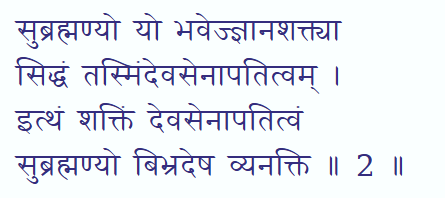
This verse is the second verse from another composition by the acharya called "Shanmukha Pancharatna Stuti". The verse goes as follows:


Here, the acharya explains why Lord Subrahmanya stands with the spear ("vel", shaktyaayudha) and with Valli and Devasena by his side. This description of Lord Subrahmanya is seen in the 3rd and 4th lines. 

In the first two lines, the acharya says:

If a person is blessed by Subrahmanya with "Complete Knowledge" (line 1) (gnyaana shaktyaa), that Gnyaani...becomes Subrahmanya Himself (subrahmanyah  bhavet (line 1)). (We are reminded of the Upanishad phrase- brahma veda...brahma eva bhavati).

And what happens to this gnyaani, the who has become Subrahmanya himself? The acharya says in the second line- the gnyaani becomes so great and has such power (siddhi) that he commands respect (patitvam, i.e. lordship) from the entire army/retinue of the devas (deva-senaa) (line 2). Even devas worship this gnyaani, the verse says.

We notice the pun on the word "Deva-sena". It is used as both "Devasena" (Subrahmanya's consort) as well as "Deva sena" (army of the devas (in the gnyaani context)). Similarly, the word "shakti" is used in 2 ways: as "gnyaana-shakti" (power of knowledge for a gnyaani) and as the weapon ("vel"/spear) wielded by Subrahmanya. The word "subrahmanya" is also used in 2 ways: for a gnyaani and for the Lord. The word "pati" is used twice- in the sense of "lordship" for a gnyaani and again as the spouse/consort of Devasena! Almost every word is repeated in this verse...once for Lord Subrahmanya and a second time for a gnynaani (who is now identical with Subrahmanya!)

In Verse 1 (that we saw earlier), Subrahmanya was presented as the "destroyer of ignorance". In this verse, we see the same idea presented positively- as the "giver of knowledge". 

Thus, the 2 verses are connected.

Verse 3:

Subrahmanya at Tiruchendur- Rivers merge in the ocean:

The next verse is taken from yet another composition by the acharya called "Subrahmanya Bhujanga Strotra". 

Readers will recall that Adi Shankara has composed the famous Subrahmanya Bhujanga Stotra. The 34th acharya has also composed a stotra by the same name, on the same deity at Tiruchendur. Another common point in both compositions is that Subrahmanya, Tiruchendur, the ocean etc...everything is described using a "spiritual metaphor" and compared to the spiritual journey of a seeker.

Bhujanga is a snake. Subrahmanya is often worshipped as a snake. Hence, the name Bhujanga here. Bhujanga is also a particular "metre" in Sanskrit poetry. In the Bhujanga metre, each line of the verse will have "1 short syllable followed by 2 long syllables" repeated. As a snake moves, it coils and expands. This spring-like movement is shown using the repetition of a short syllable followed by a long syllable. These verses- though called "bhujanga", do not follow the bhujanga metre. However, we can still see a natural "flow" and "movement" in these verses. 

This verse is a natural progression from the above 2 verses. In verse 1, ignorance was destroyed. In verse 2, knowledge was gained. In this verse, Lord Subrahmanya blesses the devotee who becomes a gnyaani, and how that gnyaani relates to the varied experiences of the world. We can call this "gnyaana phalam", the result of knowledge.

The verse goes as follows:


 At Tiruchendur, Lord Subrahmanya stands majestic...facing the ocean. 

This verse too starts by talking about the ocean, samudram. The acharya says, rivers (tatinyah), travel from afar and finally abide (samshrayantey) in the ocean. And how do the rivers unite with the ocean? By losing their "names" (abhidhaa) and "form" (rupa). One river may be white in colour and named Ganga. Another river may be dark in colour and named Yamuna. But once they merge in the ocean, they lose (viheena) their identity. There is no Ganga and Yamuna anymore. There is only...one ocean...devoid of all names and forms. We see this merger described in the first line.

The acharya says- a similar "merger" is seen in a gnyaani, the one who knows "Me" (maam pra-vignyaaya) (line 2). Like the river that loses its identity in the ocean, a gnyaani has no more connection with "particular names and forms" of the world. He becomes one with the totality, even while he is living in this world.

It is to convey this message that Lord Subrahmanya stands like an ocean of compassion (dayaa-abdhi) on the ocean-front (says the last quarter of the second line).

We are reminded of the famous Bhagavad Geeta verse (Chapter 2) that uses the same "ocean" metaphor for a gnyaani and how "rivers of experiences", some good, some bad, all merge in him, causing no ripple whatsoever.

With this, we pray to Lord Subrahmanya and the acharya to bless us. May we lose our ignorance. May we gain that complete knowledge. May we...become one with the totality....and be totally free...here and now.

References:

The Harikatha: (Do listen to the narration and music here! The above essay is based on this.)

https://www.youtube.com/watch?v=Wpl54unHoe4  

The stotras:

https://vairaagya.wordpress.com/2017/12/03/34th-sringeri-jagadguru-shri-sharavanabhava-maanasa-puja-stotram/

https://vignanam.org/hindi/sri-shanmukha-pancharatna-stuti.html

https://sanskritdocuments.org/doc_subrahmanya/subrabhujanga4.html


Friday, 27 June 2025

Gems from the acharya- A Harikatha on Lord Ganesha

This write-up is based on a Harikatha by Smt Sharada Gannavaram ji that I heard recently. The link for this Harikatha is provided at the end of this article. Rasikas will surely enjoy the talk and the music. 

The uniqueness of this Harikatha is the usage of shlokas composed by Sringeri's 34th acharya- Sri Sri Jagadguru Chandrashekhara Bharati mahaswami (1892 - 1954).

Adi Shankara is revered as the "shanmata sthaapana" acharya- the one who established equal worship for the 6 deities- Ganapati, Subramanya, Shiva, Surya, Devi and Vishnu. All these deities are the same, and depending on our attraction for a particular deity, we can choose any deity as our ishta devata.

The 34th acharya has composed verses on all these 6 deities. We begin with a peek into some verses composed by him on Ganapati.

We will look at 3 verses on Ganesha from acharya's works. The first two are from the "Ganesha Stuti Manjari".

Verse 1: (Verse 4 of Ganesha Stuti Manjari)


AadhoraNaa ankusham etya hastey

gajam vishikshanta iti prathaasti

panchaasya-suunur-gaja eva hastey

dhrtvaa ankusham bhaati vichitram etat

Ganesha as "panchaasya suunu":

The acharya exclaims, "Aho vichitram etat!" "What a wonder this is!" What is the wonder?  He says Ganesha is no ordinary elephant. He is unique because he is not the son (suunu) of another elephant! He is "panchaasya suunu". Here, we have a nice wordplay. Aasyam is face. Pancha has 2 meanings. It can refer to the number 5 or it can refer to something wide, something expansive. If pancha is taken as the number 5, it will refer to Lord Shiva, who has 5 faces (Sadyojaata, Vaamadeva, Aghora, Tatpurusha and Ishaana). With this meaning, Ganesha is Shiva's son- panchaasya suunu. We are familiar with this. 

But the pun on the word pancha, with its alternate meaning, makes this shloka interesting. A lion is called "panchaasya" because the lion has an expanded face. As per this, Ganesha, who is an elephant, is the son of a lion (panchaasya suunu)! Normally, the elephant is mortally scared of a lion. We are aware of expressions like "simha swapnam"- even a lion in dream...scares an elephant. But in this unique case, Ganesha is panchaasya suunu, an elephant, born of a lion, as it were. Thus, the opposites- a lion and an elephant come together...in Ganesha!

Ganesha and ankusham:

In the first line, the acharya mentions another wonder. Normally, the ankusham, the spear, is carried by the mahout (aadhoraNaa). The mahout wields the ankusham to control the elephant. But Ganesha is unique because here, the elephant is holding the ankusham! Why does Ganesha hold the ankusham? He controls the mind of all the bhaktas using his ankusham. We see the benevolence of Ganesha, who carefully protects his devotees, by goading them in the right direction.

Verse 2: (Verse 11 of Ganesha Stuti Manjari)


ganDa-sravat-svachha-mada-pravaaha-gangaa

kataaksha-arka-sutaa yutashcha

Ganesha as Gaja-Prayaaga:

The acharya here talks about a male elephant that is in rut. The "mada jala" is secreted and flows down the cheek of this elephant. The acharya says, this "mada pravaaha" is white in colour (svachha) and this flow of mada...is like the river Ganga.  Readers will recall that Ganga ji is also considered "shveta varna" (white in colour). Such a pure (svachha) and white mada pravaaha flows down the cheek of Ganesha.

Next, the acharya focuses on the "kataaksha", the divine gaze of Ganesha. Even here, there is a pravaaha, a torrent. It is a torrent of compassion. He likens the black eye of Ganesha and the ensuing flow of compassion to the river Yamuna (arka sutaa). Readers will recall that Yamuna is considered black in colour. She is associated with Sri Krishna and hence black. Yamuna is also Surya bhagavan's daughter.  Hence, Yamuna is called "arka (sun) sutaa" in this verse.

We have seen Ganga and Yamuna flowing on Ganesha's face. Our curiosity is kindled. What is going to come next?

The acharya says:

jihvaanchaley-gupta-vahat-saraswati-yuta

There is one more pravaaha flowing from the face of Ganesha. What is it? It is the "vaak pravaaha", the flow of speech, the flow of knowledge...from the mouth of Ganesha. This is the river Saraswati, the acharya says. His keen attention to detail is seen here. He intentionally uses the word "gupta"- which means "covered" or "unseen". An elephant's mouth is covered by the trunk- it is "gupta". So too, the river Saraswati is unseen.

The acharya continues:

Ayam aabhaati gaja-prayaagah

Here, the acharya finally ties the analogy together by summarising that on Ganesha's face, we have a "gaja prayaaga"! It is a Prayaaga, a Triveni, a Sangama...where Ganga, Yamuna and Saraswati...all of them come together on Ganesha's mukha!

We notice how the acharya uses similar sounding words- "pravaaha" and "prayaaga" to heighten the poetic effect.

Verse 3:

Ganesha as the bestower of tri-murti-sthaanam:

Next, we look at another interesting verse. Acharya composes a shloka triggered by his observation of things and events around him. Apparently, he composed this verse during a Ganesha Chaturthi celebration at Sringeri where Lord Ganesha's vigraha was placed along with other artefacts like a lotus and a bird. These artefacts were meant for Ganesha's sport (kreedaartham)! Hence, the reference to a lotus and a bird and a snake in this verse. 

The verse goes as follows:

Kamalam-taarkshyam-sarpam nikatey.....kim artham eesha suuno?

Hey eesha-suuno, Lord Shiva's son! Why do you have a lotus (kamalam), Garuda (taarkshyam) and a snake (sarpam) close to you? 

The acharya himself answers this question in the next line. 

aasana vaahana bhushana daanaartham

He says, Ganesha keeps a lotus, a bird, and a snake with him so that he can give them (daanaartham) to his devotees! He says, the lotus (kamalam) will serve as a seat (aasana), the bird (Garuda) will serve as a vaahana (vehicle) and the snake will serve as an ornament (bhushana) for his devotees. We are left bewildered as to why a devotee will need all of this- a lotus as a seat, Garuda as a vaahana etc. 

The acharya solves the riddle.  He says Kamala-aasana refers to Lord Brahma. Taarkshya or Garuda-vaahana refers to Lord Vishnu. And Sarpa-bhushana refers to Lord Shiva. He further elaborates that giving the lotus, bird and snake to his devotees is like bestowing the "tri-murti tulya sthaanam" on them. That is, Ganesha's grace is so boundless, that his devotees become as prominent as the "tri-murtis" themselves! What greater goal can the devotee ask for? The verse ends on this dramatic note.

As we have seen, these shlokas are beautiful. The message and the poetic excellence- make them so endearing!

With this, we pray to Lord Ganesha...that he may bestow his grace on all of us.

References:

Ganesha Stuti Manjari:

https://sanskritdocuments.org/doc_ganesha/gaNeshastutimanjarI.html

The Harikatha that served as the reference:

https://www.youtube.com/watch?v=mR-we5RpIZg


Saturday, 5 April 2025

Rose-milk!

“Rose-milk” runs in the family’s genes. No wonder, the tastebuds are so strikingly similar…spanning multiple generations! When the family folklore is written down one day, Rose-milk will surely occupy a place of pride!

The story goes back to pre-independent India…to the temple town of Tiruvidaimarudur. That’s where father and uncle grew up. In that idyllic township, a veritable “Malgudi”, was a tiny shop called “Ganesh Cooldrinks”! Ganesh Cooldrinks served the best “Crush”, “Sharbat”, “Badam-milk” and “Rose-milk”. No one served Rose-milk as tasty as Ganesh Cooldrinks, or so it seemed, after father’s narration.

“Did you and uncle drink Rose-milk every day at the shop? Everyday…you drank Rose-milk? Everyday? What was the color of the Rose-milk? Was it deep-rose in color or was it light-pink? And…and…was the Rose-milk topped with ice-cubes also?”- you could not curb my childish curiosity!

In another incident, uncle was apparently tempted by Rose-milk sold at Chengelpet station and forced father to buy a glass. One sip and uncle gave up! It tasted horrible, far removed from the delicacy served at Ganesh Cooldrinks. Father had no choice but to drink the rest of it, though it tasted yucky!

When there is so much build-up to Rose-milk…as a child, I had no choice, but to fall for it. Rose-milk was the most fascinating drink on the planet. Even the name “Rose-milk” was so compelling! I could drink Rose-milk thrice a day, perhaps more. When we visited a relative’s home and was offered Bournvita or Horlicks, I quickly turned it down, with a forthright counter question, “I hate Bournvita! Can I have ice-cold Rose-milk instead?”

Certain pleasures are uniquely Indian. When the sun beats down in the summer months…scorching the earth and whipping up a cloud of hot dust…man, animal and bird, everyone runs for cover. The throat is parched and bone-dry. You long for some instant relief.

Imagine ice-cold Rose-milk served on such a fiery afternoon! The feeling is unmatched. The air is redolent…with the fragrance of rose…and with the aroma of “Gulkand”! The glass is full…up to the rim! Ice-cubes float…in the crimson tinged…Rose-milk concoction! As your fingers grip the glass, beads of water droplets condense on the outer walls …and gleam like fine-cut diamonds! It looks so delicious that you gulp and swallow inadvertently, even before you’ve taken the first sip! And the moment you raise the glass to the lips, sweetness fills your entire being! If there is Amrta, if there is Happiness…it is here and now, right in this glass!

Ironically, you do not want to take another sip! The Rose-milk level is sinking; it is such a deflating feeling! A few gulps and it’s over. Once the glass is empty, you tilt your head back and hold the glass vertical! Rose-milk is too precious- not a drop…not a trickle…must be wasted!

The other day, I spotted Rose-milk syrup at the way-side grocery store. Needless to say, I bought the syrup instantly. Sometimes, sitting a work, right in the middle of a deep, technical meeting, the Rose-milk thought will suddenly flash across the mind, bringing an instant smile. It is the smile of anticipation- you look forward…to rush home and drink some ice-cold Rose-milk!

Life is like a glass of Rose-milk. It gives nuggets of happiness…that may be few and far between. But no worries! The remainder of the time, we recollect and relive those special moments…a second time…this time through memory. That reminder is enough… enough to light up the face.

Memory serves as the pleasant aftertaste; the aftertaste that lingers…well after the Rose-milk is over!

Saturday, 29 March 2025

The bread winner!

Sometimes, I seriously feel, I would have been a baker in a past life! Nothing else can explain the absolute delight, I find in bread! It is tough to explain the feeling to a non-believer. I can eat bread for 365 days of the year and more! Even the word “break-fast” is a misnomer- it should have been “bread-fast”!

The peculiar fascination for bread can lead to tricky situations. When you go on a trip, you often wake up in the morning, in time for “continental breakfast” at the hotel. There is an entire “spread”, arranged in buffet style. In India, you cannot beat the variety at breakfast. There’s steaming Idli and spicy Sambar, delicious Upma and sumptuous Pongal. You open the next casket on the breakfast counter. Once the mist of the emanating steam settles down, the eye comes face to face with golden Vadas. And yonder, there is crisp Masala Dosa, inviting you with the shine of burnished gold. For a foodie, this is heaven. Full-stop!

Something is clearly amiss. I summon the hotel manager and pop my question, “Where is bread?” He takes time to respond, as though, he’s taking time to process the word.  Totally puzzled, he fumbles, “Bread? Bread?”  Even my family is aghast, “There’s so much variety! Why would you eat bread? You can anyway eat bread at home!”

A bread lover has no explanation. It’s like the episode from the Mahabharata. Before the war, Krishna gave 2 choices to Arjuna and Duryodhana. One choice was to opt for Krishna’s entire Yadava army- all his soldiers, his infantry and cavalry, everyone armed to the teeth. The other choice was to opt for one individual- a non-combatant Krishna. Arjuna made the first choice and chose Krishna. Duryodhana couldn’t believe Arjuna could make such a ridiculous choice! When there was such abundance of power and might in the Yadava army, how could Arjuna opt for a measly Krishna?

For some of us, bread is like the choice Arjuna made! It is a “no-brainer”- there is no choice really.  It does not matter…what else is pitted against bread. Bread wins, hands down, each time, every time! The non-believer scoffs at bread as “tasteless” and “food meant for the sick and the convalescent!”

Father, forgive them, for they know not, what they say! Bread has infinite variety that a non-believer fails to see. We have “bread with jam”, “bread with butter”, “bread with ketchup”, “bread with cucumber and tomato” …what to talk of more exotic concoctions like “bread upma” and “bread pakoda”!

Plain bread is comfort food- soft and fluffy with its unique, subtle taste. Toasted bread, on the other hand, is a completely different breed. The moment it pops off the toaster, it is irresistible- tasty, crunchy and crispy!  Your finger runs after even the crumbs that scatter around with each bite! And then…when it comes to “Rusk” with hot masala tea in the late afternoon- the combination has no contenders!

Bread is your all weather, all-day friend!

These days, there’s a bewildering variety within the bread kingdom. We have “white bread” and “milk bread”, “wheat bread” and “muti-grain bread” and even “sweet bread” and “fruit bread”.  Bread’s close cousins, the “bun” and the Mumbai “pav” are undeniably important players in bread’s dream-team!

In the 1970s, the film “Deewar” had an iconic dialogue between Amitabh and Shashi Kapoor. Amitabh taunts Shashi Kapoor, “I have everything! Aaj mere paas…gaadi hai, bangla hai, bank balance hai! What do you have? Kya hai tumhare paas?” Shashi Kapoor looks at Amitabh in the eye and answers softly, “Mere paas maa hai! Mother is on my side!”

In my version of “Deewar”, this dialogue will get a complete makeover. Amitabh will spew venom with, “Aaj mere paas…sab kuch hai…Idli hai, Dosa hai, Samosa hai, Pongal hai! Kya hai tumhare paas?” Shashi Kapoor will now answer, “Mere paas bread hai!”

Bread is the ultimate winner. No wonder, we still ask, “Who is the bread winner of the family? We do not ask, “Who is the Idli winner or the Dosa winner?” Do we?


Saturday, 8 March 2025

The book-browser!

Yes, I am a “book-browser”. I browse through books at the bookstore, but I never buy a single book! My defense is this- my wife and children have bought enough and more books from the same bookstore, for over a decade. Those purchases should surely give me some additional perks, shouldn’t they? Why can't I be a book-browser then?

Every evening, I walk to this bookstore at the mall. The only variable in my daily, well-oiled routine is to pull out a book at random! Yes! Open a random book to a random page. That done, I will carefully browse through that one page, as though, it has a specific, pointed message meant for me, for that day! It takes me exactly 10 minutes for this entire exercise. That done, I will place the book back in the shelf and leave the bookstore.

It is a routine that I have followed for months, may be, years. About 2 weeks ago, an attendant manning the aisles, accosted me as I read my book-for-the-day. He said, “Sir! 5 minutes!”  I was puzzled. Never has someone delivered such a pointblank, abrupt message to a book-browser.

After all, a book-browser is well-versed with all the tricks that storeowners use to evict him. An attendant will suddenly appear out of nowhere, to re-arrange the books on that one shelf, against which, the book-browser is leaning. But a book-browser knows how to deal with these attempts to thwart him. He side-steps the attendant and walks away, carrying the book in his hand. Standing at a different corner of the store, he continues his browsing.

Soon, someone comes along and pops a question, “Can I help you sir? Is there a specific book that you are looking for…sir?”  The book-browser is a seasoned campaigner. Experience has taught him to respond with an evasive answer, “No! Thank-you! I can help myself!” and buries himself back in the book.

Next, a security man comes his way. The trick is to avoid eye-contact with any security person.  That singular act renders the security man defenseless. You casually turn around and face the other way, till he goes past you. In some time, he is sure to appear from the opposite end of the aisle. You repeat the same tactics- turn around, face the other way, and continue your reading.

The other nasty methods that bookstore owners use…is to switch off the fan and the lights, in that specific section of the store. Or they broadcast the recorded message, "The store is about to close in 10 minutes!" Why do bookstore folks harbor such obvious hatred for the book-browser, we wonder.

The book-browser is often asked, “Why don’t you buy the blessed book?” People miss the point. The book-browser is not a book reader. A book-browser has neither the patience nor the attention-span to read a book. He is incapable! He simply likes the company of the book.  He likes the feel of the book resting on his palm, he likes to twirl the pages a few times and perhaps read a page or two. And yes, he likes to flit from book to book, like a bee stopping for a moment or two, at each flower! He feels erudite, informed, and knowledgeable in handling the book, without reading it ever…in its entirety! Why can’t we allow the book-browser this innocent pleasure, I say?

“5 minutes only!” the security person curtly repeated at the bookstore. I asked him, “5 minutes for what?” He replied, “For reading the book!”

Strangely, ironically, the book in my hand was a copy of the Bhaagavata Puraana. As per tradition, this book had a timespan associated with it. King Pareekshit had exactly 7 days to internalize this material. The story goes that the king successfully completed the study in those 7 days. And here was this security person saying I had “5 minutes” to read the same book!

I read the book for the full 5 minutes. And once the 5 minutes was over, I placed the book back in the shelf and headed home!

Friday, 17 January 2025

Running errands- techniques to never run another!

Let’s face it. No one wants to run errands. However, you are coerced into this activity, with no wiggle-room whatsoever. Here are some time-tested techniques. If you follow them to the letter, rest assured, you will never have to run another errand.

The first technique is simple.  You wear down the errand-assigner by asking questions and more questions. Let’s say, as a kid, mother asks you to buy 500 gm of sugar. You start a questioning trail as follows- “Which shop should I go to? What if “Kani stores” is closed? What if “Chhada stores” is also closed? What if the shop has run out of sugar? What if he has run out of powdered sugar, but carries sugar-crystals, should I buy the crystal-sugar? What if I forget "500 gm" and say "500 kg" instead? What if he has no sugar, can I buy salt? What if it costs more money than the amount I am carrying? Ok. I will buy 250 gm instead of 500 gm. How much will 250 gm be? This big? What if the shopkeeper has run out of change to give back? What alternate knick-knacks should I buy for the extra change? What if I drop the money…accidentally…before going to the shop? What if I buy the sugar…but there’s a hole in the packet, so much so, by the time, I get home…it’s all gone?” The errand-assigner will eventually relieve you from the onerous task with the following closing remarks, “Instead of answering all your questions, I would rather do it myself! It will be much faster!” That said, you can still go to school, and in the “good deeds done for the week” section, write out a sentence in all seriousness, “Helped elders at home to run errands!”

The second method is to commit mistakes.  The blunder must be of such gigantic proportions that the errand-assigner should never assign you the next task! Most errand assigners will start with one item. It will be something simplistic, “Can you buy some bread?” Obviously, there is no need to write down “buy bread” on a piece of paper. That is plain silly and a waste of paper (and yes, trees also).  By the time you get ready to run the errand, one more item will be added to the list. While you wear your chappals, two more items will be added. And, as you step out of the door, the total number of items will swell to 9. Since you never started out writing the items on paper, the 9 items will all be in your head. By the time you reach the shop, 7 out of 9 would have evaporated! Yes, evaporated into thin air! You recall “bread” and “rice flour” and no more! It’s like the sudden amnesia Karna suffered on the battlefield. What can you do now ? (Remember, there was no cellphone back then). You buy the bread and rice-flour and return!

The next time, the errand-assigner will take no chances. She will hand over to you...a piece of paper with all the items...written down. You make no mistakes this time. When you get back, “What happened to the rest of the items?” Your response- “There are no other items. This is all you wrote out!” “Didn’t you turn the page and look on the other side?” That’s when it hits you! “But…but…you didn’t write PTO at the end of the page! How should I know...the back of the paper also carries items?” The damage is irreparable. You are now stuck with mustard…an entire packet…but not the “rava” to make upma with!

Sometimes, it is a problem of plenty. The errand-list carries a simplistic item- “rice”. When you reach the shop, there is “premium rice”, "raw rice", “idli rice”, “par-boiled rice”, “HB rice”, “basmati rice” and “ponni rice”! There is no hope in hell you can get it right. Whatever you buy, you will be in trouble. You come home huffing and puffing carrying 10 kgs of rice! “Idli rice? Idli rice? Why did you buy 10 kg of idli rice?” When it comes to “dals”, there is eternal confusion. You were asked to buy “tur dal”, but after a lot of deliberation, you carefully picked the packet of “chana dal”! I tell you…the two fellows are identical twins- totally indistinguishable! Or…you were asked to buy “dishwasher soap” and you bought a gallon of “detergent” instead! Logic does not work here. “Sab saabun hi hai naa? It’s all soap only…right? What is the big deal?”- this argument will not work, my dear!

In some cases, you feel you have successfully run the errand. You buy potatoes and cabbage...and return. “Why did you buy potatoes and cabbage? This is what I explicitly asked you…NOT to buy! We just ate potato and cabbage this week!” This is a familiar trap that every errand-runner faces. The problem is with the errand-assigner. Never use negative logic, technically called "neti-neti" logic. “Don’t buy this!” just does not work! It must always be a clear, positive, firm, affirmation…in the imperative mood- “Buy this, buy that!"

I don’t run errands anymore. You can see why!